

About the manual
The Primary Clinical Care Manual (PCCM) is a clinical guide for health professionals working in rural, remote and isolated settings.
Structure and format
The manual is divided into sections and subsections, organised by topic or the body system affected.
Sections
- Patient assessment and transport
- Pain, nausea and vomiting
- Emergency
- General
- Mental health and alcohol withdrawal
- Obstetrics and neonatal
- Sexual and reproductive health
- Paediatrics
- Immunisation
- Appendices
Topic format
- Recommend and background
- Related topics
- May present with
- Immediate management
- Clinical assessment
- Management
- Follow up
- Referral/consultation
Drug (medicine) boxes
Drug (medicine) boxes include:
- the generic name and schedule of the medicine
- extended authority in Queensland
- the form, strength, route, dose and duration of the medicine
- consumer medicine information (CMI) - includes selected points only, not full versions
- contraindication
- management of associated emergency.
Health management protocols and clinical care guidelines
Some topics are marked with HMP (health management protocol). This means they include a medicine that can be used by a clinician with extended practice authority in Queensland. Topics without HMP are clinical care guidelines.
References
The evidence used for each edition is listed in the Primary Clinical Care Manual references (PDF 879 kB).
Review process
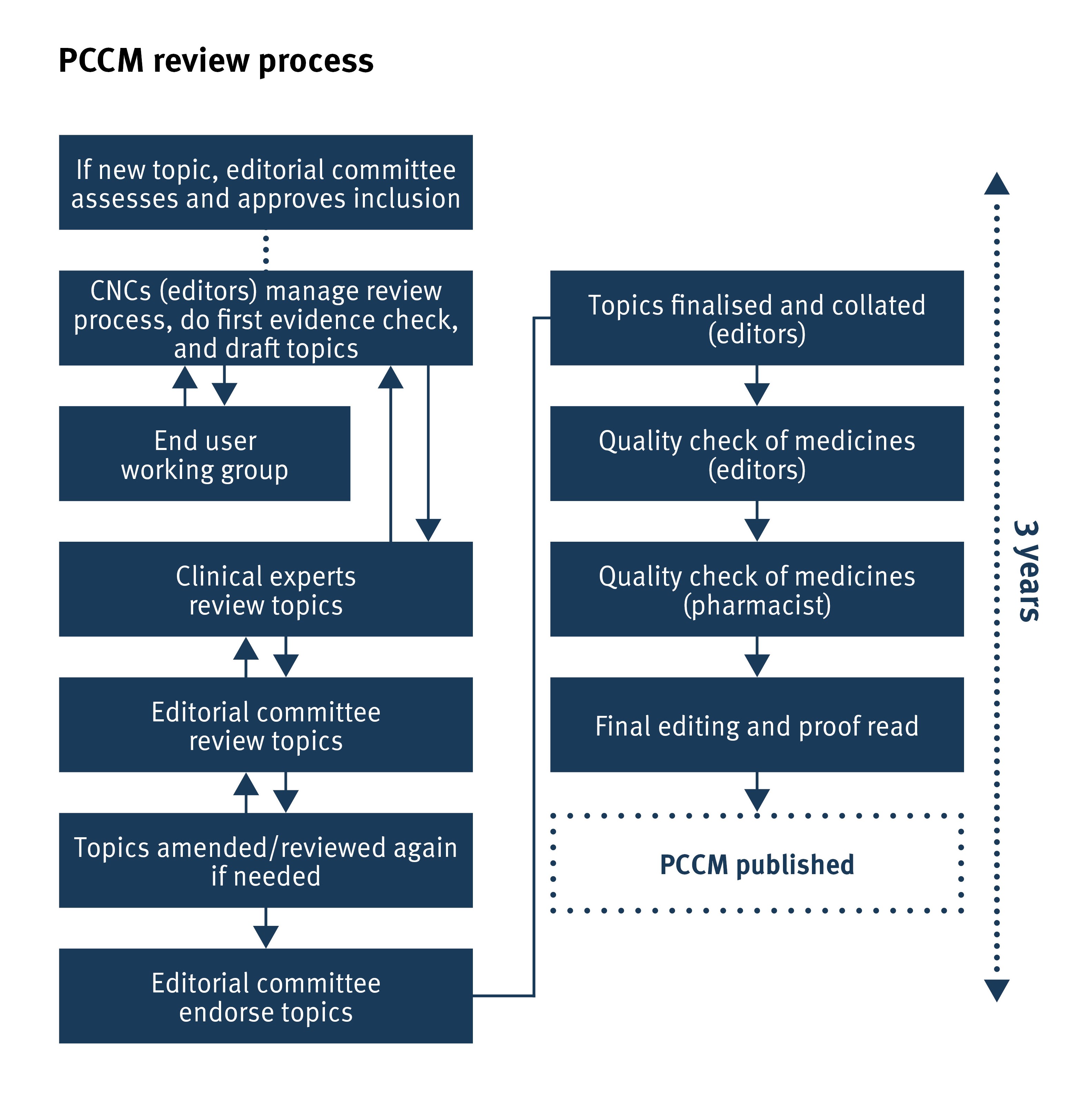
We publish the PCCM every 3 years.
- If a new topic, it is assessed and approved by the editorial committee.
- Clinical nurse consultant (CNC) editors manage the review process, do first evidence check, and draft topics.
- An end user working group provide feedback on general usability of the PCCM.
- Clinical experts review drafted topics in collaboration with the editors.
- Topics then progress to the editorial committee for review and endorsement.
- Topics are then finalised and collated into a book.
- All medicines are quality checked by the editors and a pharmacist.
- Final edit and proofread.
- The new edition is published.
Clinical nurse consultant editors
Clinical nurse consultant (CNC) editors are experienced in rural, remote, and isolated practice area nursing and midwifery.
They're responsible for:
- managing the review process
- researching clinical evidence
- preparing the initial draft of topics
- editorial control, including style, tone, and relevance to rural, remote and isolated practice.
End user working group
End users are clinicians from rural, remote, and isolated practice areas who use the PCCM in their day to day practice.
They give advice from a user's perspective, including content, formatting, and how easy the manual is to use.
Clinical experts
Clinical experts are subject matter experts. They:
- review drafted topics
- assess evidence
- work with editors until the topic is ready for presentation to the editorial committee.
Editorial committee
Our committee represents diversity and experience across various rural, remote, and isolated practice areas. It includes the following clinical groups of about 15 people with a broad range of skills and backgrounds.
- Medical officers
- Rural and isolated practice registered nurses (RIPRNs) from Queensland and Victoria
- Nurse practitioners
- Midwives
- Aboriginal and Torres Strait Islander Health Practitioners
- Clinical leads from Queensland Ambulance Service, the Australian Defence Force, Remote Primary Health Care Manuals (CARPA), and the Cunningham Centre RIPRN course
- Pharmacists.
It also includes cultural practice and consumer representatives.
The committee is chaired by a senior medical officer, which alternates between Queensland Health and Royal Flying Doctor Service (Queensland Section) each edition.
Committee members must declare any conflict of interest at the start of each meeting.
They're responsible for:
- assessing and approving new topics
- reviewing new content
- endorsing publication of new content and topics.
Feedback
Last updated: 24 July 2026