

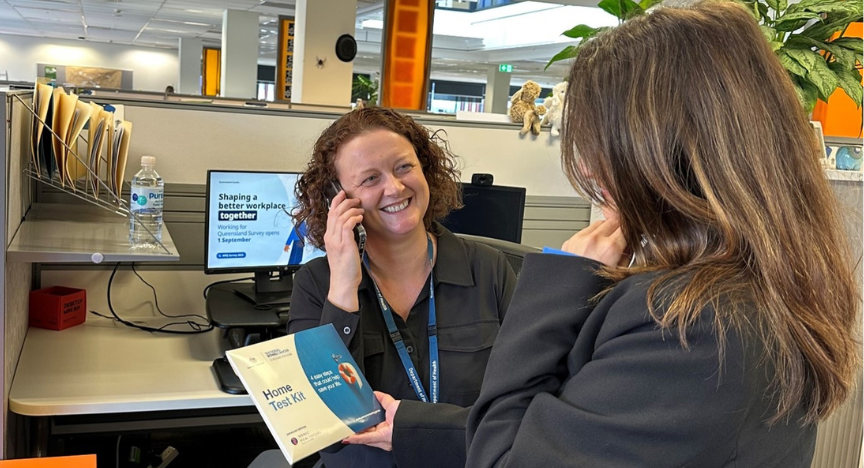
The Queensland Participation Follow Up Function team make thousands of calls per year to encourage at-risk patients to make an appointment with their doctor.
For some people, intense pain, unexplained weight loss and blood in the stool are the first signs that something is wrong.
But for many who show no symptoms at all, bowel cancer can lurk in silence until it’s uncovered in a lab.
With the risk of one in every 20 Queenslanders developing the disease, early detection is crucial.
This is where the health team that manages positive bowel cancer screening results comes in, often saving someone’s future with a single timely phone call.
The Queensland Participant Follow Up Function (PFUF) contacts at-risk participants to encourage them to make an appointment with their doctor.
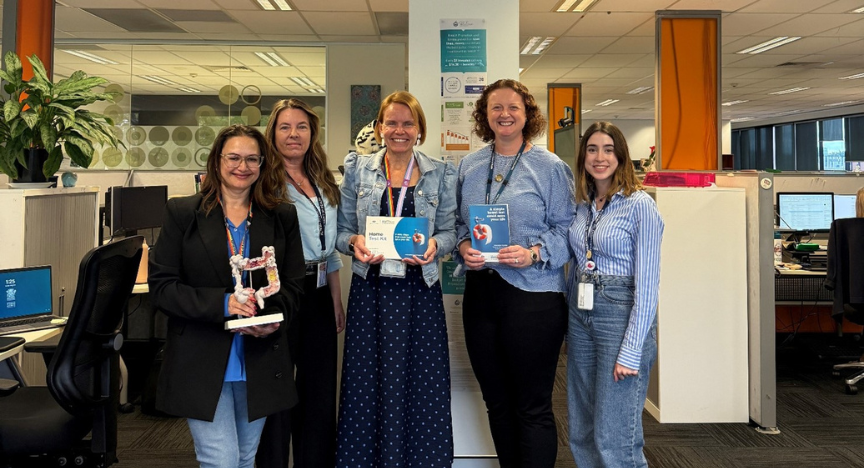
“The conversation can go anywhere,” Queensland PFUF team leader Nicola Foley said.
“The calls can get quite personal because our advice can come at a happy or difficult time in their life, from someone telling us about their holiday to hearing about someone who lost a family member.
“We find many people have no symptoms at all, so we’re met with disbelief. This is where we explain the results and why it’s important to book in their follow-up appointment.”
In 2024, PFUF made more than 6,400 phone calls and followed up 8,990 participants whose poo samples contained traces of blood.
The team manages to get participants to follow-up appointments in 5-7 days on average, blitzing their 28-day target.
Nicola said bowel (or colorectal) cancer was the second deadliest cancer in Australia.
“It’s important to act early and quickly because nine out of 10 cases where bowel cancer is detected can be treated successfully,” she said.
The most effective way of finding early signs of bowel cancer is the free, at-home bowel screening test every two years for those aged 45 to 74, as part of the National Bowel Cancer Screening Program (NBCSP).
The chance of getting bowel cancer increases with age.
The national free kit identifies any traces of blood in you poo that could be a sign of cancer or pre-cancerous growth.
Reluctance or forgetfulness to follow up on results that show these signs could make a difference in receiving a positive outcome.
For Queenslanders aged 50 to 74 (the age typically invited to screen in the NBCSP) one in 806 are diagnosed with colorectal cancer each year.
People aged 45 to 49 can opt in and request their first bowel cancer screening kit.
In Queensland between 2016 and 2020, 63 per cent of people survived the first five years after diagnosis. This is eight per cent lower than the national five-year survival rate.
Nicola said PFUF was a safety net for National Bowel Cancer Screening Program participants and their healthcare providers.
“PFUF officers are able to have in depth and informative conversations with people who have returned a positive bowel screening test,” she said.
“Officers can explain why it’s important to complete their follow-up and answer any questions or concerns they might have about the necessary next steps.
“They can also check that public hospital referrals for a colonoscopy are being received and actioned, and often chase up lost referrals to ensure that participant care is not delayed.”
Queensland PFUF officers made more than 25,700 interactions, including calling participants, GPs and specialists, emailing facilities and checking databases, in 2024.
Nicola said she was proud her team was contributing to Queensland’s diagnostic assessment rate of almost 90 per cent, which was higher than Australia’s overall figure.
“It is very rewarding to see that they are happy with the information and support we provide them,” she said.
“It’s a great feeling knowing that we’re making a difference in people’s lives.”
Across the country, it’s not mandatory for pathology providers to enter histology data into the National Cancer Screening Register (NCSR).
Queensland’s PFUF team is the first in the country to undertake this crucial task which registers a participant’s colonoscopy and outcome data, which ensures they’re on the correct screening pathway.
The team has already entered 4,000 histology forms into the NCSR, which accounts for over 60 per cent of the national histology data collected.
“We are proud to say our proactive approach has been endorsed by the Commonwealth for other states and territories to adopt as they come on-board,” Nicola said.
For more information, please visit The National Bowel Cancer Screening Program in Queensland | Queensland Health