

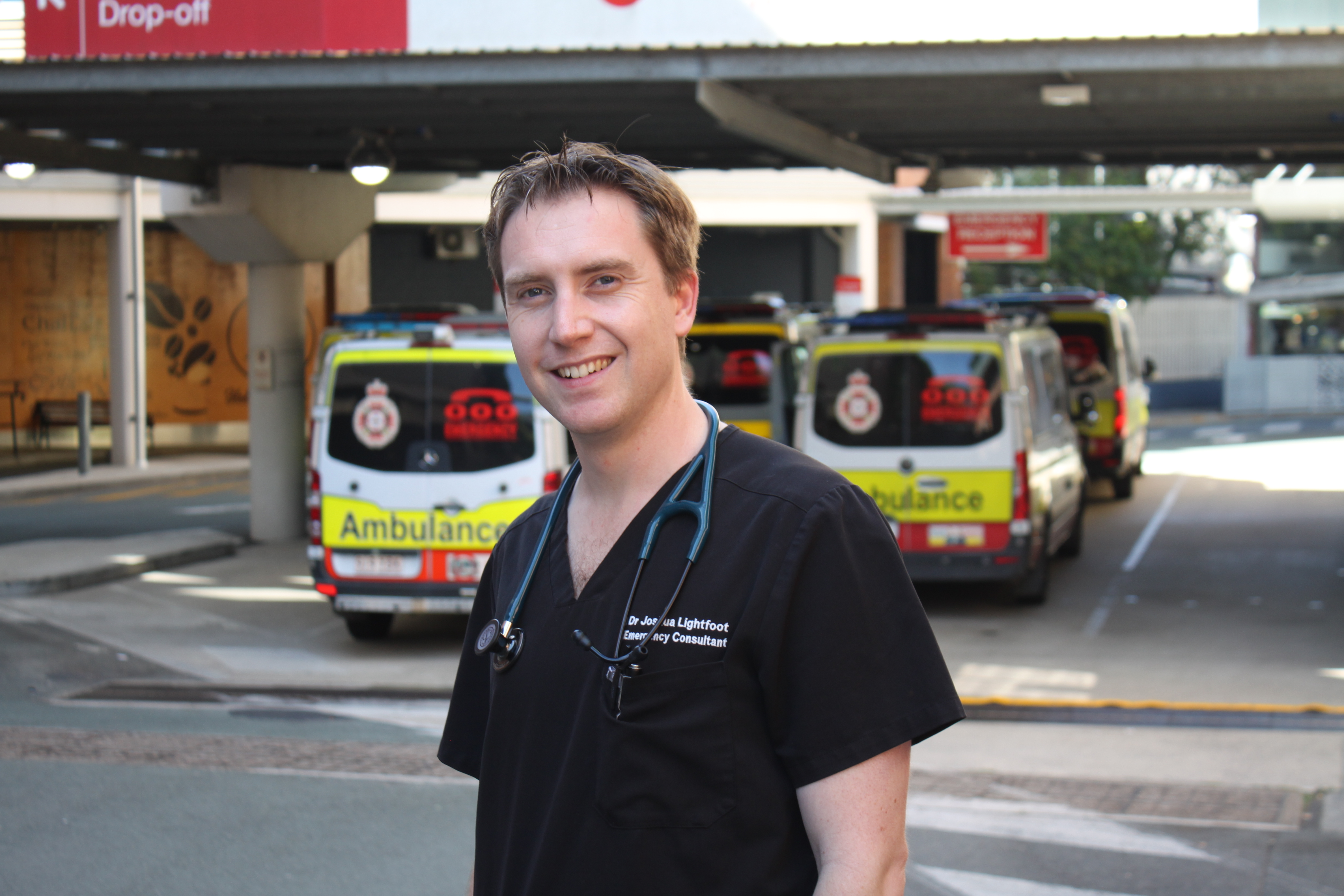
Emergency Consultant Dr Joshua Lightfoot shares a medical commander role with other senior doctors at Ipswich Hospital. The role is intstrumental in supporting patient flow through the emergency department.
In the role of medical commander at a busy emergency department, emergency consultant Dr Joshua Lightfoot helps guide patients safely through an unpredictable and ever-changing environment.
Every shift he works is a careful balancing act to prioritise the sickest patients, while ensuring timely care for everyone else.
A typical day may involve rushing a patient to a resuscitation bay with a life-threatening condition; continuing to closely monitor someone in an emergency bed; or directing another patient to the waiting room to commence their treatment while an appropriate space becomes available.
Dr Lightfoot was instrumental in establishing the medical commander role at Ipswich Hospital – a role which is now shared among senior emergency doctors during their shifts.
Each day, people present to Ipswich Hospital’s emergency department with life-threatening emergencies that require immediate care.
While a hospital’s frontline clinicians are busy focussing on individual patient care, the medical commander is working behind the scenes and looking at the bigger picture.
Their role relies on continually adapting to a shifting and evolving environment, ensuring patient care and safety remain the priority and continually reassessing people who are waiting – whether in the waiting room or arriving by ambulance.
“The dynamic can change in seconds,” said Dr Lightfoot, who has more than 13 years’ experience working in emergency departments across Australia.
“It all depends on who comes through the doors next, or whether a patient suddenly deteriorates.”
As ambulances arrive and walk-in patients continue to present, Dr Lightfoot’s focus extends beyond any single bedside. His role is to hold the whole department in view –constantly assessing where each patient needs to be to ensure they receive safe and timely care.
“Rather than concentrating on one patient, the medical commander sees the bigger picture,” he said.
“We’re tracking new arrivals, test results, incoming ambulances, available beds, patients who are ready to go home, and anyone whose condition might be worsening. All of that information matters, all of the time.”
This oversight allows doctors and nurses at the bedside to focus fully on the person in front of them.
“In essence, the role exists to support frontline clinicians,” Dr Lightfoot said.
“It gives them confidence that someone is watching the whole emergency department, so they can concentrate on individual patient care.”
“Unfortunately, with unprecedented levels of hospital presentations, people are having to wait longer in emergency departments, and as medical conditions can evolve from minute to minute, it is important that people are reassessed regularly while waiting.”
The medical commander role was first trialled at Gold Coast University Hospital in 2020 in response to the COVID-19 pandemic.
Following the pandemic, the demand for emergency care across Queensland remained strong, with emergency departments facing growing pressures from an ageing and rapidly increasing population and people presenting with more complex health needs.
Each month, around 200,000 people seek care across Queensland’s 106 public emergency departments. About 60,000 arrive by ambulance, while thousands more walk in, uncertain of what lies ahead but trusting they will be cared for.
The medical commander role now forms part of Queensland Health’s broader efforts to improve patient flow in the state’s busiest emergency departments and has been implemented across eight hospital and health services, including West Moreton, Wide Bay, Sunshine Coast, Metro South, Metro North, Mackay, Darling Downs and Central Queensland.