
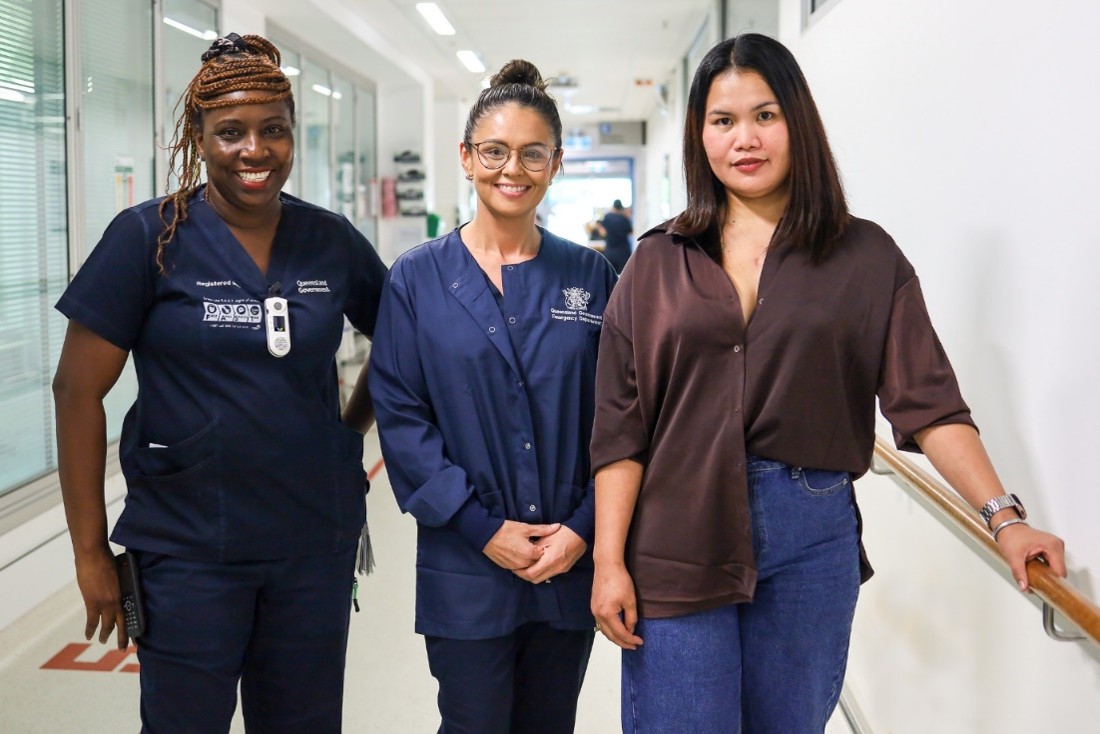
Nurse practitioner Helen Nengasha, ED Nurse Educator Kreya Gudenswager and Queensland Telestroke Service patient Angelica Murray.
For 37-year-old Mackay mum Angelica Murray, a sudden stroke turned an ordinary day into a race against time.
Angelica suffered a stroke while out with a friend. Within minutes of arriving at Mackay Hospital, she was taken for urgent brain imaging, connected by video to a specialist stroke neurologist and shortly after, received life-saving clot-busting medication to treat her symptoms.
“I was in the car with my friend and suddenly I couldn’t concentrate or remember names,” Angelica said.
“I tried to say something, but I couldn’t get the words out. I even looked at my husband’s name on my phone and couldn’t recognise it.”
As her condition deteriorated, her friend rushed her to hospital.
“I asked, ‘what is your name again?’ and that’s when she knew something was really wrong,” she said.
At the emergency department, staff immediately recognised the signs of stroke.
Unable to communicate clearly, Angelica pointed to her medical bracelet to help clinicians understand an existing medical condition.
“I was confused and scared at the same time,” she said.
“But I remember all the nurses and doctors working together so quickly. They were explaining everything, even the stroke doctor on the screen.”
For Angelica, that speed made all the difference.
Thanks to advice from a Queensland Telestroke Service (QTS) neurologist, Angelica received the clot busting medication she needed, and her symptoms began to resolve.
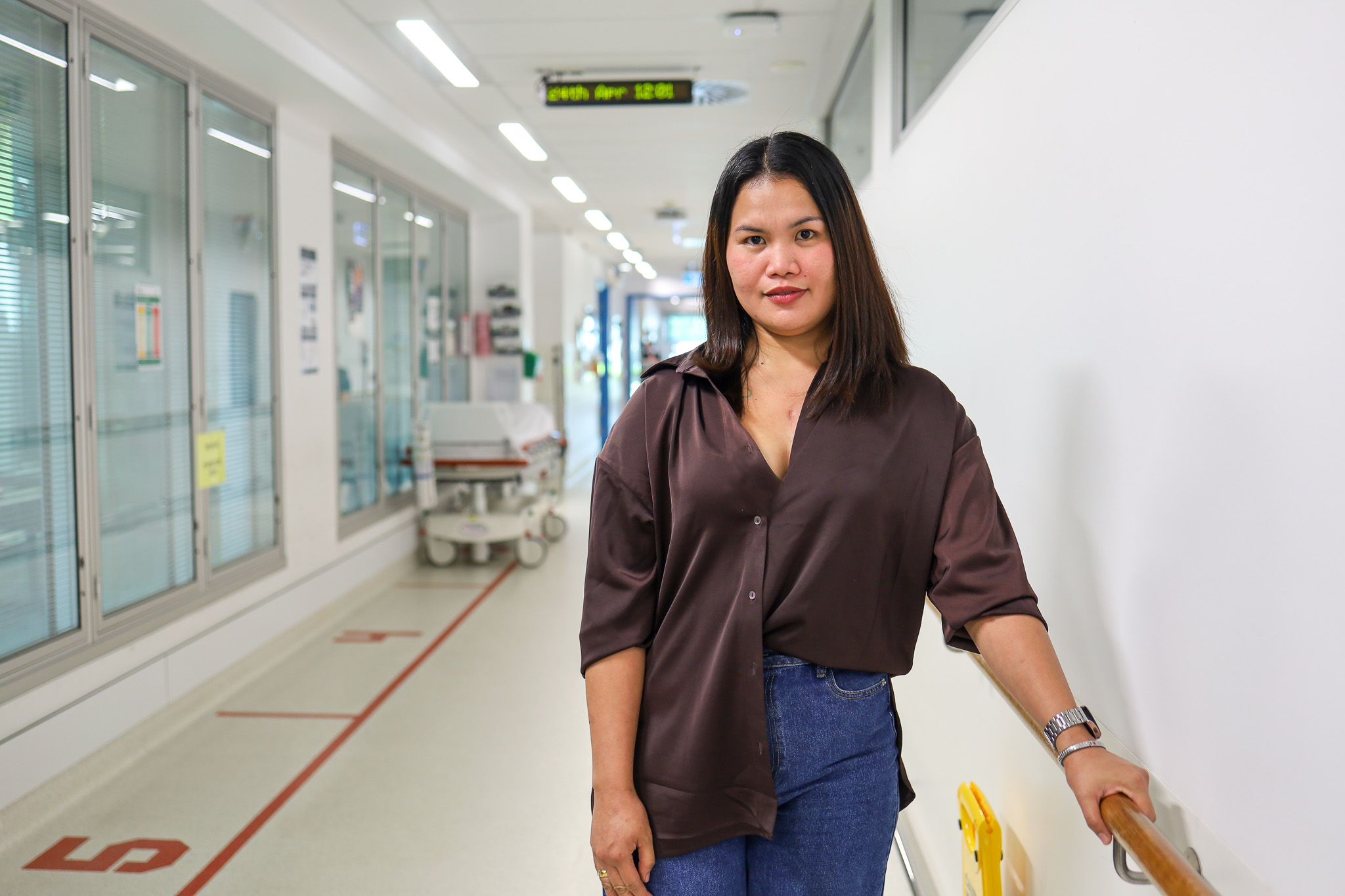
“I started feeling better after a couple of hours,” she said.
“I was transferred to the ICU, where I stayed for a week, then they continued to provide care for me through the Hospital in the Home service.”
Angelica is one of a growing number of regional Queenslanders benefiting from the QTS, with Mackay Hospital now recording some of the fastest stroke treatment times in the state.
QTS is currently live across ten Queensland sites (Hervey Bay, Bundaberg, Ipswich, Mackay, Toowoomba, Kingaroy, Rockhampton, Bowen, Proserpine, and Gladstone hospitals – plus a planned rollout to another 12 by 2028) with more than 850 patients being treated through the service so far.
It is helping ensure patients in regional communities can access specialist stroke care just as quickly as those in major centres, giving them the best possible chance of recovery.
Mackay stroke nurse Helen Nengasha, who has spent more than a decade caring for stroke patients, said seeing outcomes like Angelica's was exactly why the team had embraced the new model of care.
"I didn't start out specialising in stroke, but over time it just grew into a real passion – the brain, the urgency, the impact you can have," Helen said.
That impact is now being felt more than ever at Mackay Hospital, where the introduction of QTS has streamlined care for patients experiencing time-critical strokes.
While the hospital already had a strong foundation in stroke care before the new service, Helen noted that relying on larger, busier centres could present its own set of challenges.
She said the team had already laid the groundwork, but the implementation of the new service was the missing piece.
“We’d done the hard work already – it was like the system just needed ironing out,” Helen said.
“QTS came in and really streamlined everything. Now there’s a clear pathway, everyone knows their role, and we’re all working together seamlessly.”
She added that the impact on patients was profound.
“Now, it doesn’t matter where you live, you can get that expert care straight away.
“It’s a real equaliser.”
Through QTS, clinicians can connect instantly with specialist neurologists via video. This enables faster diagnosis and treatment decisions, which is particularly critical in stroke care, where every minute counts.
The results at Mackay Hospital have been striking.
The team recorded some of the fastest “door-to-needle” times in Queensland, which is the time it takes from a patient arriving at hospital to receiving the clot-busting medication.
In one recent case, the team achieved treatment in just 42 minutes, well under the national 60-minute benchmark.
“That’s the fastest we’ve ever done,” Helen said.
“It’s something the whole team is really proud of. Seeing those results lifts morale because you know you’re making a real difference.”
For Angelica, the experience has been life-changing and eye-opening.
“I want to say a massive thank you to all the doctors and nurses at Mackay Base Hospital who looked after me, checked on me and made sure I was okay,” she said.
“Their kindness and care meant so much to me – especially during such a scary time.
“I never expected to have a stroke, but now I know how important it is to act fast. I’m just grateful I can still talk, walk, and be home with my kids.”
For Helen and her team, that outcome is exactly what the service is designed to achieve.
“At the end of the day,” Helen said, “it’s about giving patients the best possible chance.”