

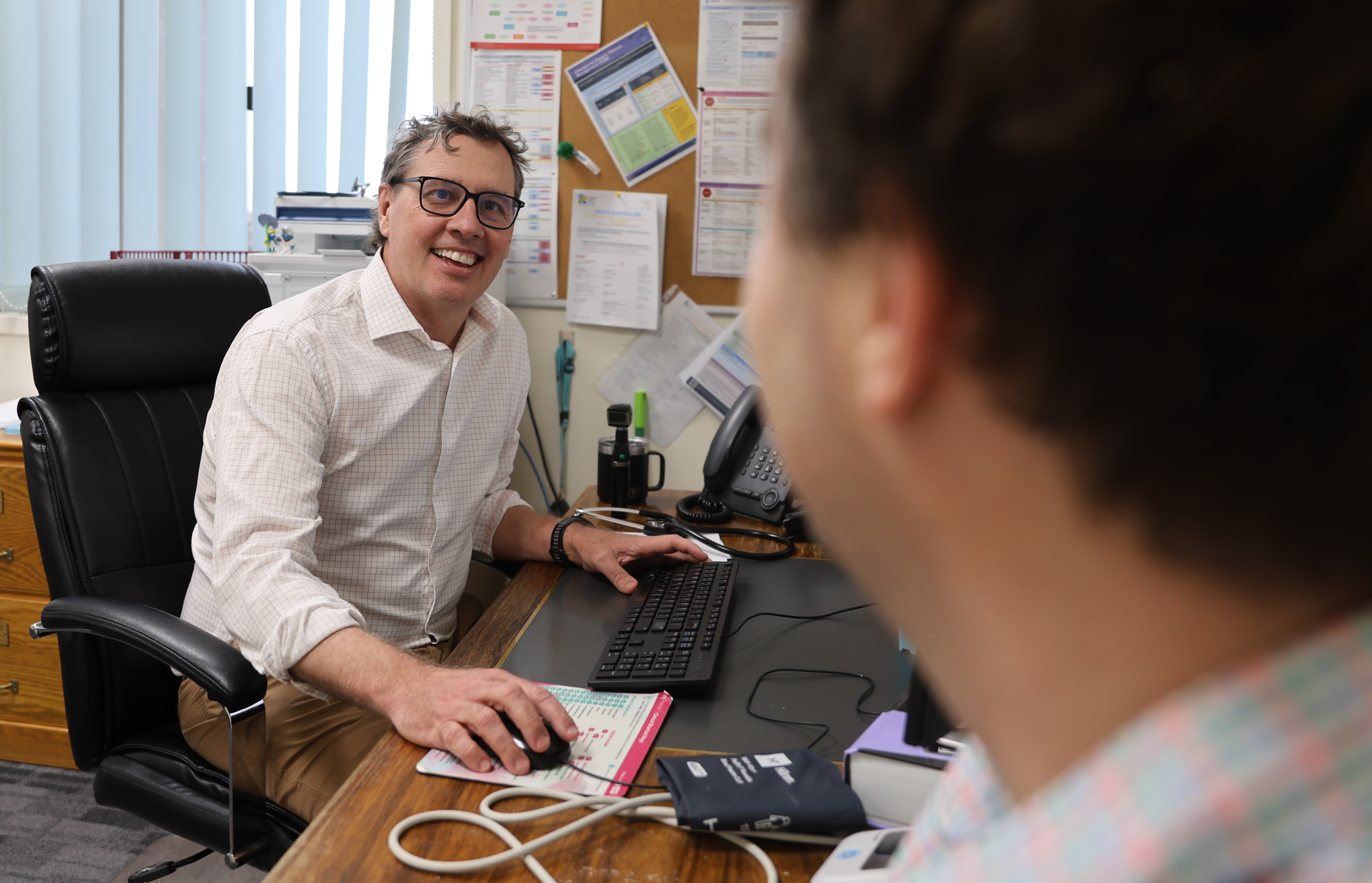
Dr David Walker is the Executive Director of Medical Services at the Central West Hospital and Health Service based in Longreach.
While growing up, Dr David Walker saw firsthand the incredible impact a doctor can have on a small country community.
Although his General Practitioner mother Carmel discouraged him and his siblings from pursuing what can be a demanding career in medicine, Dr Walker decided to follow in her footsteps.
He is now the Executive Director of Medical Services at the Central West Hospital and Health Service based in Longreach.
Every day he strives to improve the lives of his own rural community, located a little more than 1000 kilometres west of where he grew up near Gympie.
As a Rural Generalist with mental health advanced skills training and a passion for men’s health, he stressed that getting on the path to a healthier and more fulfilling life always starts with small steps.
Suicide and coronary heart disease rates for men in regional and very remote areas of Australia are about double what they are in the cities, and these are the two biggest areas of concern for Dr Walker.
Over his career working in rural medicine, he has seen positive developments in men’s health but a corrosive stigma about seeking help still persists.
Men in the bush traditionally won’t ask for help if they’re struggling or may not truly grasp how much their physical and mental health has deteriorated.
Sometimes it takes those who know them best - a partner, sibling, child or mate – to spot the warning signs.
Men's health facts
Daily smoker
Major cities (11.4%) vs outer regional and remote (21.8% )
Insufficient physical activity
Major cities (36.3%) vs outer regional and remote (42.6%)
Overweight or obese
Major cities (70.8%) vs outer regional and remote (72.4%)
Diabetes
Major cities (15.3%) vs outer regional and remote (18.2%)
Median age at death
Major cities (80.2) vs remote (74.2)
City vs country (men and women)
Coronary heart disease
Major cities (9.5%) vs remote and very remote (21.3%)
Suicide and self-inflicted injuries
Major cities (5.1%) vs remote and very remote (10.1%)
Type 2 diabetes mellitus
Major cities (3.7%) vs remote and very remote (7.4%)
Dr Walker said giving a loved one a nudge towards getting help can be life-changing and set them down the path to better long-term health.
“It could be anything that's out of the ordinary,” he said.
“If someone's not acting themselves, then I think there’s that opportunity to ask ‘are you ok’ and just check in. Take the time to listen.
“Encourage them to get help. You don’t have to solve everything yourself but I think just being there as that first port of call is a really helpful thing.”
Risk factors for heart disease including smoking, obesity and diabetes are all more prevalent in men living in regional areas than in urban centres.
“It’s staggering those statistics exist in 2026,” Dr Walker said.
“Realistically there are concerns about confidentiality and the fact you’re not particularly anonymous in small towns.
“We need to work hard to break down that barrier to men presenting.
“The reality is there are some societal norms that still exist where we expect our men to be strong and self-sufficient. They don’t feel open to talking about their worries and problems. Those regional areas haven’t quite caught up in that sense.”
Dr Walker urged men struggling with their health to make an appointment with a GP to identify the issues and make a gameplan which stayed between patient and doctor.
“Unfortunately, the statistics are still there and they’re hard to argue with at the moment,” he said.
“But it is changing. Often the health issues that we develop don't occur overnight, so we shouldn't expect them to go away overnight. There’s a lot of work we’re doing to combat that.
“We’re continually working to raise awareness about the challenges being faced by rural men and, particularly in the Central West, we’re striving to strengthen our medical workforce and our general practices to facilitate better access for men seeking help.
“We’re chipping away at that resistance from men to get help. If it’s been a while, book a double or a long appointment with your doctor so you can take the time, get the support you need, and work through things together."
Qld Day is an annual celebration, marking the state’s birthday on 6 June.
The search is now on for amazing Queenslanders – those selfless community volunteers, local legends, young achievers, organisation and most importantly, our health heroes. Nominations for Qld Day are open online until 18 May 2026.