

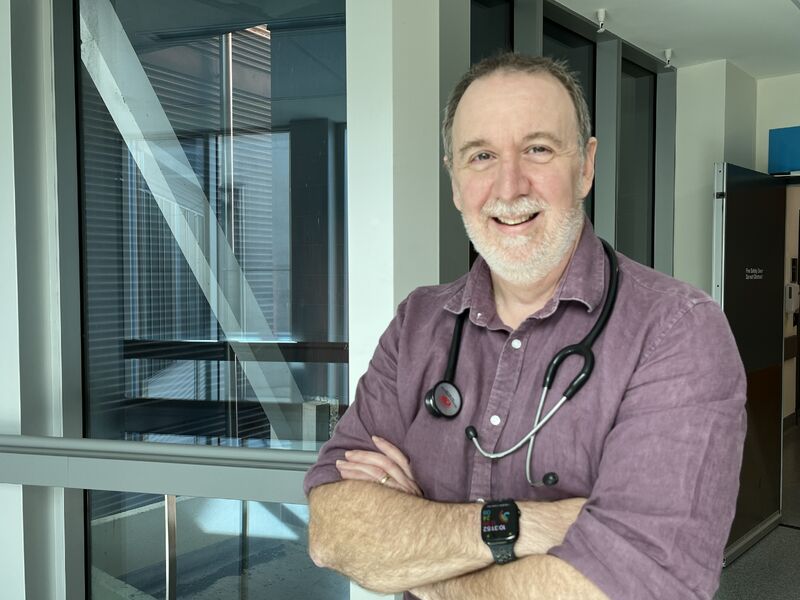
Dr Ross Cruikshank is a Medical Oncologist and Palliative Care Physician, serving as director of the Department of Palliative Care at Ipswich Hospital.
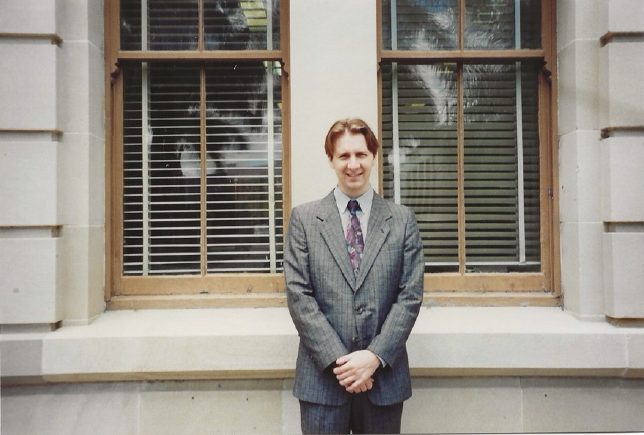
After ten years in the legal field, Ross Cruikshank’s spark for the work had faded, but the experience provided a glimpse into the medical world and inspired a career change.
In need of change
During his time as a lawyer specialising in personal injury, the only bright spot in Ross’s workday came when he was trawling through medical records and hospital reports.
At 29-years-old – with ten years of legal study and work under his belt – he knew he needed to make a change.
Though it meant committing to years of study and training in a new field, he took the leap of faith.
The Graduate Medical School Admissions Test (GAMSAT) provided a pathway, allowing him to pursue a career he was truly passionate about.
Finding his passion
He found that building trust was the biggest parallel between working in law and medicine.
“In both cases you’ve got someone coming to you with a problem,” Dr Cruikshank said.
“You need to be able to listen, gain information and narrow down what the issues are.
“Establishing rapport is one of the most important aspects of medicine. You need to have that strong patient-to-doctor relationship.
“You’re not going to have a good outcome if you don’t have a patient that has some degree of confidence in who you are and what you’re going.”
Back in the books
After passing the GAMSAT and a further four years of postgraduate study, Dr Cruikshank was drawn to oncology.
However, with a new baby and another young child at home, he decided that going straight into medical oncology advanced training would be too intense.
“I had two very young children, so I thought I’d take a 12-month sabbatical,” he explained.
He took a position as a palliative care registrar at Redcliffe Hospital as a temporary pitstop, intending only to catch his breath before starting oncology training.
Yet, the Mackay native quickly found an affinity for the speciality and saw how closely the two fields intertwine.
After finishing his two-year oncology training in 2012 he bookended it with another 12 months of palliative care training to secure qualification in both specialities.
Making the most of the time we have
“With oncology and, especially with palliative care, you’re taking that journey with a patient and ensuring that journey is going to be as comfortable as possible,” Dr Cruikshank said.
“With our palliative care patients, they know they’ve only got a finite period, and the focus is really on quality of life for the time they have left.
“Often it falls to us to explain what that final journey looks like. If we can communicate that to the patient effectively and provide reassurance, then that’s really half the battle won.
“If you can see the reassurance in their eyes when they realise they've got a whole team of doctors, nurses and allied health there to comfort them, that's really fulfilling.”
Embedded in the West Moreton community
In 2014 the opportunity to pursue both specialities in Ipswich presented itself.
“At the time Ipswich had a fledgling oncology service with only visiting oncologists from Mater and only one position for palliative care,” he said.
“Now, 12 years later we have a fully independent oncology service with seven oncologists managing all types of cancer and a comprehensive palliative care service.
“We also have eight palliative care physicians providing care to inpatients, outpatients, patients in the community and rural areas, including Esk, Boonah, Gatton and Laidley.”
With over 20 years in medicine, Dr Cruikshank has enjoyed a fulfilling and rewarding career and a legacy that has shaped healthcare for the West Moreton community.
It all started with a tentative decision at 29-years-old to switch gears and pursue a career he was truly passionate about.
“If there’s something you really want to do that you think is going to make your life more fulfilling, then I don’t think there’s really any limitation in terms of age as to when you can make that change,” Dr Cruikshank said.
“It’s worth taking that chance rather than spending the rest of your time, no matter how much or how little you have left, doing something you simply don’t enjoy.”