

The following article discusses domestic, family and sexual violence.
If you or someone you know is experiencing domestic, family, or sexual violence, help is available.
Recent data from the Australian Institute of Health and Welfare (AIHW) has revealed a rise in hospitalisations linked to domestic and family violence (DFV), with young women the most affected.
DFV accounted for 50 per cent of all assault-related hospitalisations where a perpetrator was identified, with spouses or domestic partners the most common perpetrators for female patients.
The report also found that in 2023-2024, 92 per cent of hospitalisations related to sexual assault were women, with the highest rate among women aged 20 to 24.
Domestic, family, and sexual violence is a major social, health, and welfare issue in Australia – and sadly Queensland is no exception.
Queensland Health is strengthening efforts to identify, support, and protect victim-survivors, particularly young women.
Why?
Because hospitals are often the first point of contact for victim-survivors, making health services and its workers critical intervention and support points.
In April this year, Queensland Health launched a new framework to ensure all staff appropriately understand the dynamics and impacts of DFV.
The Queensland Health Domestic and Family Violence Capability Framework also supports frontline staff respond to DFV presentations safely and appropriately.
In addition, the Queensland Health updated its DFV Toolkit of Resources to make sure all DFV training modules and resources are up-to-date and align with best practice.
Other Queensland Health responses that are helping to strengthen support for DFV victim-survivors include:
- screening and identification tools
- clinical response via DFV-trained clinicians, social workers, and mental health professionals
- care pathways that connect patients to Integrated Service Responses (ISR), Domestic and Family Violence High Risk Teams (HRT), and DFV Specialist Health Workforce Program (SHWP) clinicians
- funding for SHWPs in all Hospital and Health Services (HHSs) to build capacity in staff to response safety and appropriately to suspicions and disclosures of DFV, they can also provide specialist information to staff and provide training
- external referrals to support services such as DVConnect
- using trauma-informed language to maintain clarity in clinical documentation
- policy and system-level coordination with frameworks and guidelines.
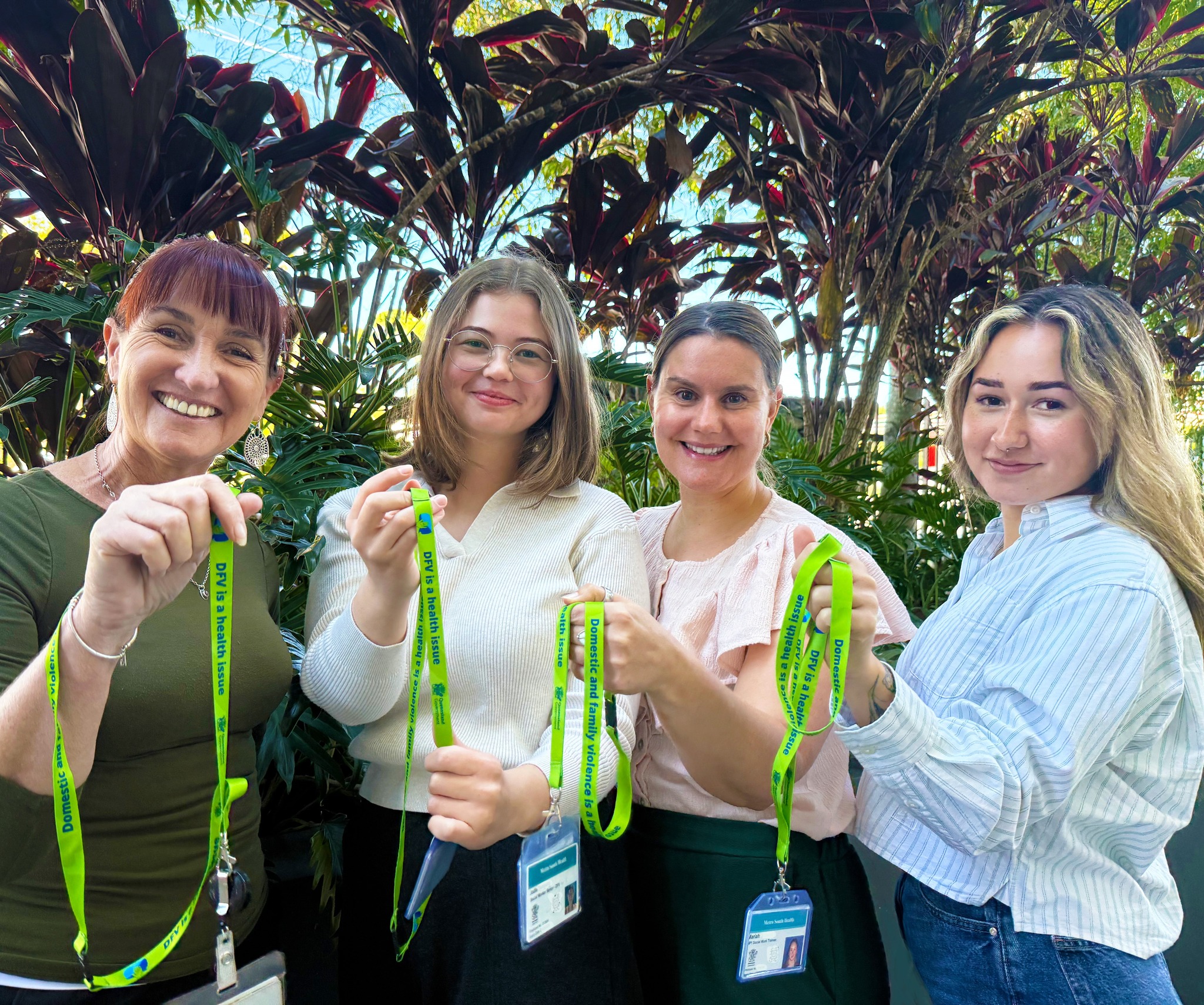
Metro South Health’s DFV Specialist Workforce Team
Metro South Health Advanced Social Worker Cindy McDowell said the AIHW statistics highlight the urgent need for more trauma-informed care and coordinated health responses.
“Domestic and family violence continues to be a major driver of hospital admissions, particularly for women and children,” Cindy said.
“It leads to repeated admissions, complex trauma presentations, and increased pressure on emergency departments, inpatient units, and community health services.
“It also leads to physical injuries, psychological trauma, anxiety and suicidal ideation, chronic health conditions, and an increased mortality risk.
“It’s so important we intervene early, provide a safe space, integrated care pathways, and particularly, ensure we have robust referral systems and post-discharge support.”
Cindy is part of Metro South Health’s DFV Specialist Workforce Team – a group dedicated to growing the health service’s response to the issue, reshaping how healthcare recognises and addresses abuse.
“Health services are often the only safe place a person can access support,” said Cindy.
“A caring response from a staff member can be life-changing; helping someone feel heard, seen, and offered safety options.”
Through clinical consultations, training, awareness events, and integration into the broader DFV sector, the team is embedding DFV as a recognised health issue across Metro South Health.
The team has already trained more than 1,700 staff in the past year and is now rolling out non-fatal strangulation training.
They also lead monthly virtual session series with external experts including a Queensland Police Service session on implementing coercive control legislation.
They’re on hand to support clinical staff across multiple disciplines by providing timely expert advice, education on managing high-risk cases, and guidance on referral pathways to partnering agencies.
“DFV is everyone’s responsibility,” said Cindy.
“We want all Metro South Health staff across clinical and non-clinical roles to feel equipped and supported. This work is complex, but no one has to do it alone.”
Metro South Health’s DFV training is mandatory for allied health professionals and highly recommended for other streams.
Allied health and nursing staff make up the majority of those who attend training.
Other Australian Institute of Health and Welfare report findings on DFV:
- One in four women and one in 14 men in 2021-2022 had experienced violence from an intimate partner since the age of 15.
- More than one in ten people with a family and domestic violence hospital stay had been admitted two or more times.
- Among all DFV hospitalisations, the most common principal diagnosis was ‘Injuries to the head’ (40 per cent).
- Every day, on average, one child has a DFV-related hospital stay.
- Since 2019-2020, rates of hospitalisation involving treatment for DFV assault by a spouse or domestic partner were around seven times higher for females than for males.
- In 2023-24, almost nine in 10 hospitalisations involving treatment for assault by a partner were for females.