

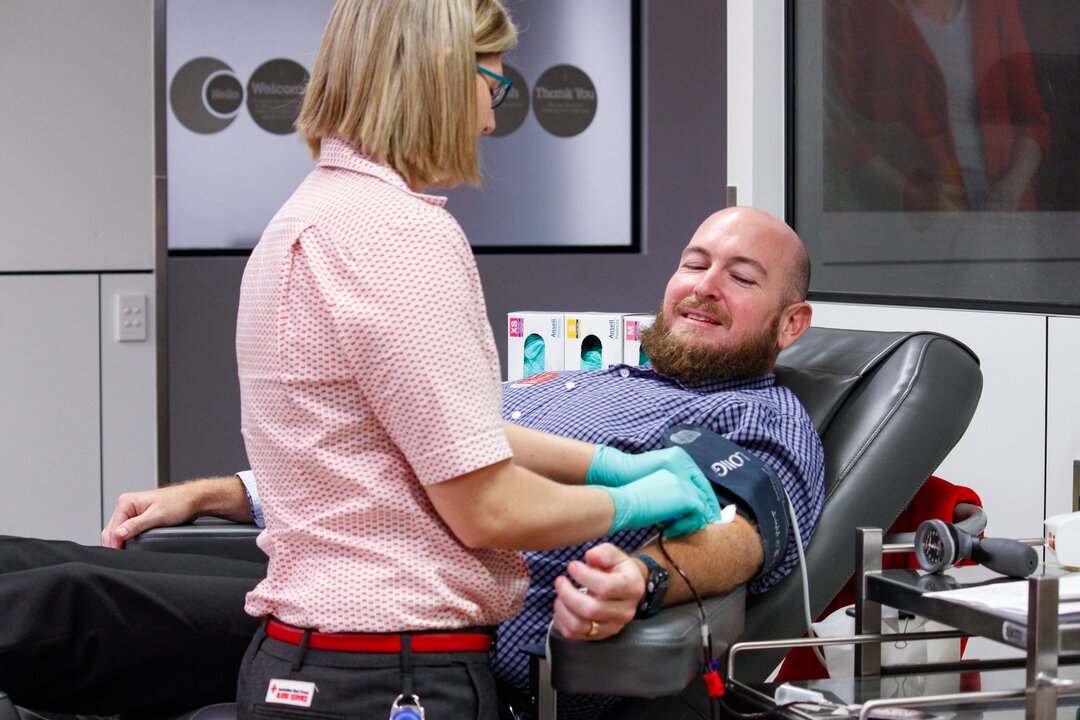
The impact of blood donation is seen every day in our hospitals, as each donation has the potential to help up to three patients.
Every day in our hospitals, you will find the impact of blood donation in almost every ward.
In oncology units, cancer patients undergoing chemotherapy rely on donated platelets to prevent life-threatening bleeding when their bone marrow can no longer produce enough of its own.
In maternity wards, a routine childbirth can become a medical emergency within minutes if a mother experiences a severe postpartum haemorrhage and requires an urgent blood transfusion.
In operating theatres and emergency departments, patients depend on donated blood to replace massive blood loss and deliver oxygen to vital organs and tissues.
Despite the highly sophisticated technology found in hospitals, some of the most life-saving treatments still depend on something we all have – human blood.
Few people understand its value better than Heather Campbell, who is a scientist at Pathology Queensland in the Gold Coast University Hospital Laboratory.
Having spent her career working with blood and seeing firsthand the difference it makes to patients, Heather has also been donating her own blood for more than 30 years.
In 2025, she contributed to the 504 donations made by Gold Coast Health staff to LifeBlood—a collective effort that could help save around 1,500 lives.
“I don’t think people realise how easy it is to donate blood and plasma,” Heather said.
“The staff at LifeBlood donation centres are incredible and take excellent care of everyone coming in to donate.”
This National Blood Donor Week (8-14 June) we encourage you to donate your blood and help keep our blood stockpiles replenished in our hospitals. Visit lifeblood.com.au for more information and to book your donation.
Donating blood remains the only solution to maintain blood supplies because human blood is so complex that science has yet to replicate it.
In an operating room, there is no substitute. No saline solution, chemical compound or sophisticated machine can perform blood’s essential role of carrying oxygen throughout the body.
Amelia Lutjens, a senior scientist in Transfusion/Haematology at the Sunshine Coast University Hospital Pathology Laboratory, said donated human blood and blood components remain the only products available for blood transfusions.
“So far science has not been able to recreate something that is as efficient as a red cell at carrying oxygen around the body.”
One of the world’s most valuable medical resources is flowing through millions of people every day, yet only one in 30 Australians donates blood.
That means just three per cent of the population helps meet a demand for blood every 18 seconds and plasma every 33 seconds across the country.
“It’s quite a process to collect, transport and store donated blood for use in hospitals,” Amelia said.
“But it is absolutely critical to have blood available for medical teams who may need it at any moment for a wide range of patients and conditions.”
Because blood products have a limited lifespan, supplies must be constantly replenished to ensure hospitals can continue providing life-saving care.
For donors, the process of donating blood may take little more than an hour.
But that simple act provides a natural resource that patients across Australia depend on every day to survive.
After donation, Lifeblood separates blood into three main components:
- Red blood cells – carry oxygen; used for patients with blood loss, anaemia, surgery or trauma
- Plasma – the liquid part of blood; used for burns, trauma and patients with clotting disorders
- Platelets – help blood clot; vital for cancer patients, especially those undergoing chemotherapy
Each whole blood donation can help up to three patients because these components are used for different medical needs.
These components are sent to hospitals and stored to maximise their viability for transfusion:
- Red cells – stored in refrigerators and safe for transfusion for up to 42 days
- Plasma – stored in freezers and safe for transfusion for up to 12 months
- Platelets – kept at room temperature and safe for transfusion for up to 7 days