

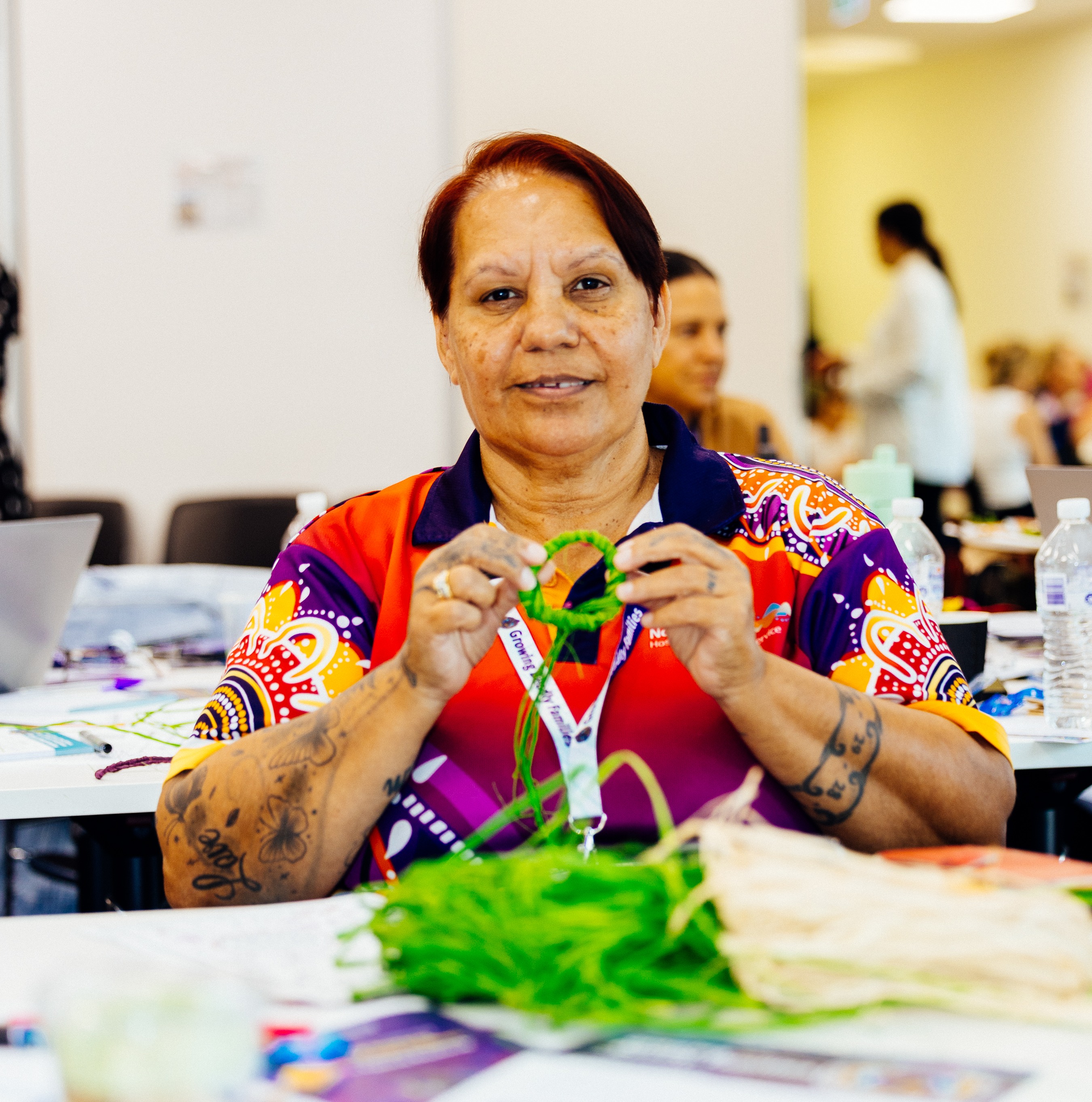
Aboriginal and Torres Strait Islander Health Practitioner Venessa Redcliffe weaving at the Growing Deadly Families Community of Practice Forum.
Summary
Aboriginal and Torres Strait Islander Health Practitioner Venessa Radcliffe shares why being there for mothers throughout their journey is deeply rewarding .
Venessa Radcliffe’s superpower is advocacy, amplifying the voices of Aboriginal and Torres Strait Islander mothers.
As an Aboriginal and Torres Strait Islander Health Practitioner in the maternity ward at Mount Isa Hospital, Venessa is known for helping Aboriginal and Torres Strait Islander women feel heard, understood and supported during pregnancy and birth.
Part of that comes from what they call “clinically yarning”, breaking down medical terminology so mothers understand and feel confident expressing their needs.
Women trust her. The community respects her. Her colleagues praise her kind and warm approach that makes a real difference in the lives of women across the region.
Venessa stepped into healthcare five years ago after being a social worker for five years.
“I light up when I go to community. I just love my job,” she said.
“I have built a beautiful rapport with all the women.”
For Venessa, the most important part of her job is making sure women feel empowered during what can be a vulnerable time.
“I give them the choice to have a voice,” she said.
“I also advocate on their behalf if they don't feel comfortable.”
One moment she will never forget was supporting a young First Nations girl who was struggling in the hospital; she refused to let doctors examine her.
“I told everybody to step out so I could have a one-on-one with her,” she said.
“She said, ‘I don’t want them to keep touching me’ and I said, ‘fair enough but you need to let me know so I can go back out and give them feedback’.
“In the end she was happy for only the midwife to do the examination.
“After delivering her baby, she was exhausted but happy and I felt good knowing that I advocated on behalf of this young girl.”

As the first point of contact for remote maternity services, Venessa travels to communities like Doomadgee and Mornington Island to ensure Aboriginal and Torres Strait Islander women have access to high-quality, culturally capable maternity care.
Working under Queensland Health’s Growing Deadly Families Strategy, Venessa’s days are busy – she might support anywhere between five and 15 women in a single day.
Her role is truly hands-on: she helps women get to appointments, accompanies them to hospital visits and provides vital support during labour.
For Venessa, being there for mothers throughout their journey is deeply rewarding.
“It’s about making sure women feel safe and supported, and making sure their voices are heard,” she said.
Venessa recently travelled to Brisbane to attend the Growing Deadly Families Community of Practice Forum, where representatives from funded sites across Queensland gathered to share learnings and strengthen maternity models of care.
The two-day forum brought together midwives, First Nations health workers, clinicians and health leaders committed to improving outcomes for Aboriginal and Torres Strait Islander mothers and babies.
“It’s always nice to come down, make new friends and network,” she said.
“Working in a small town like Mount Isa, it’s great to see what other health practitioners are doing.”
Venessa’s message to others considering this work is simple: “If you’re passionate about helping families from communities, go for it,” she said.
“At the end of the day, you’re their advocate.”
The Growing Deadly Families Strategy identifies ways Queensland Health can support effective, culturally safe maternity and birthing services to Aboriginal and Torres Strait Islander mothers, babies and their communities.