

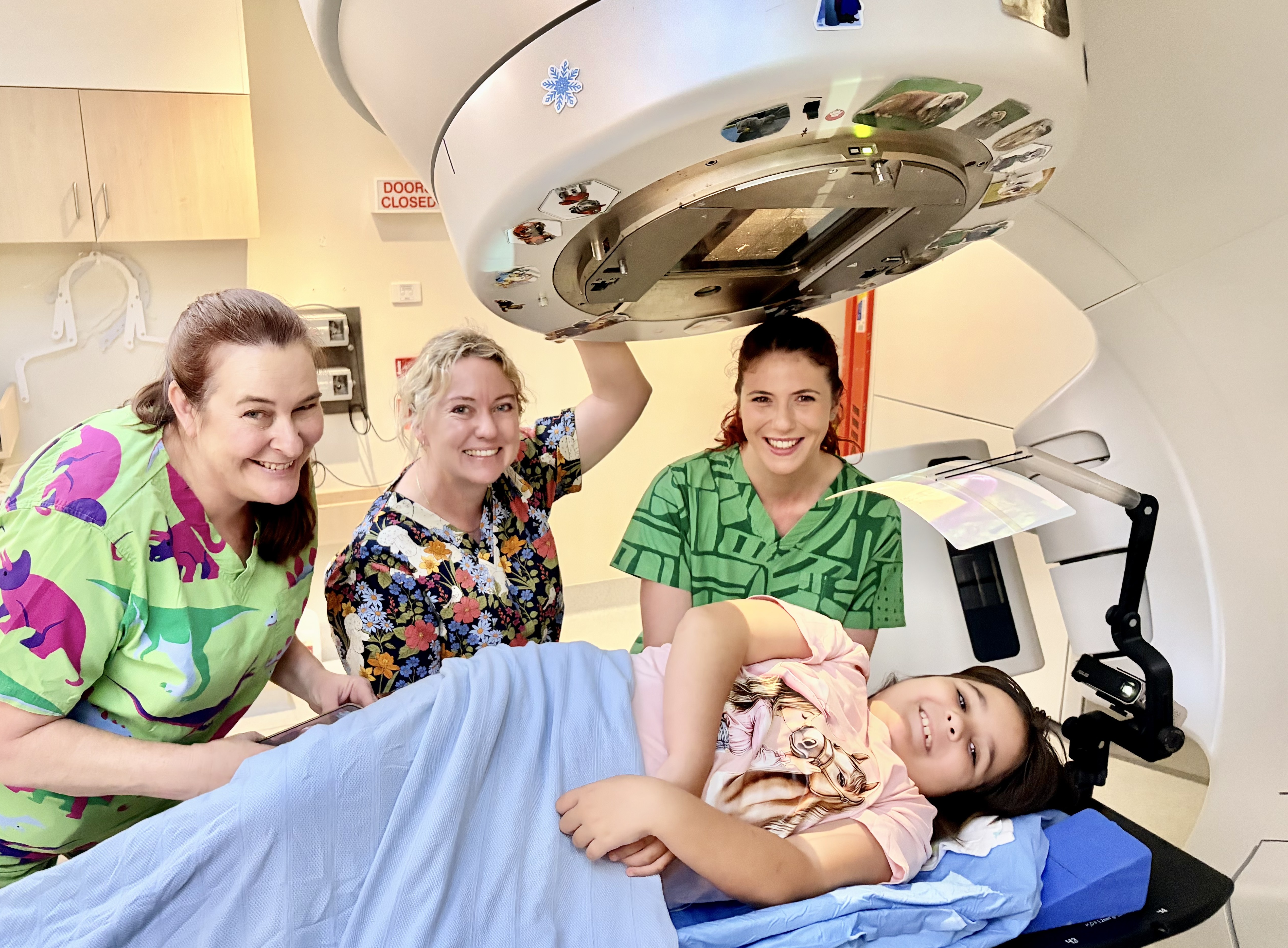
Nine-year-old Connie getting ready to watch her favourite show while undergoing radiation treatment. L-R: Aimee Welch, Narelle Wallace and Jodi Mitchell.
A simple innovation at the Princess Alexandra Hospital is helping some of Queensland’s youngest cancer patients feel more comfortable during radiation treatment.
Thanks to SPARK (Screen Platform Assistant for Radiation Oncology Kids), children undergoing treatment can now watch their favourite movies or TV shows to help them stay still and relaxed without the need for anaesthesia.
Although painless, radiation therapy can be difficult for children as they are alone in the treatment room and must remain still. This can often result in the child requiring daily general anaesthetic for treatment to proceed.
The SPARK innovation projects visual distractions onto a specially designed, 3D-printed low-density screen that allows radiation beams to pass through without affecting treatment delivery.
It overcomes former barriers such as radiation beams being blocked by iPads or tablets, or view of any projections or screens on the ceiling being interrupted by other equipment.
Jess Duggan's nine-year-old daughter Connie had daily radiation treatment for 30 days and was able to watch her favourite shows on the SPARK screen.
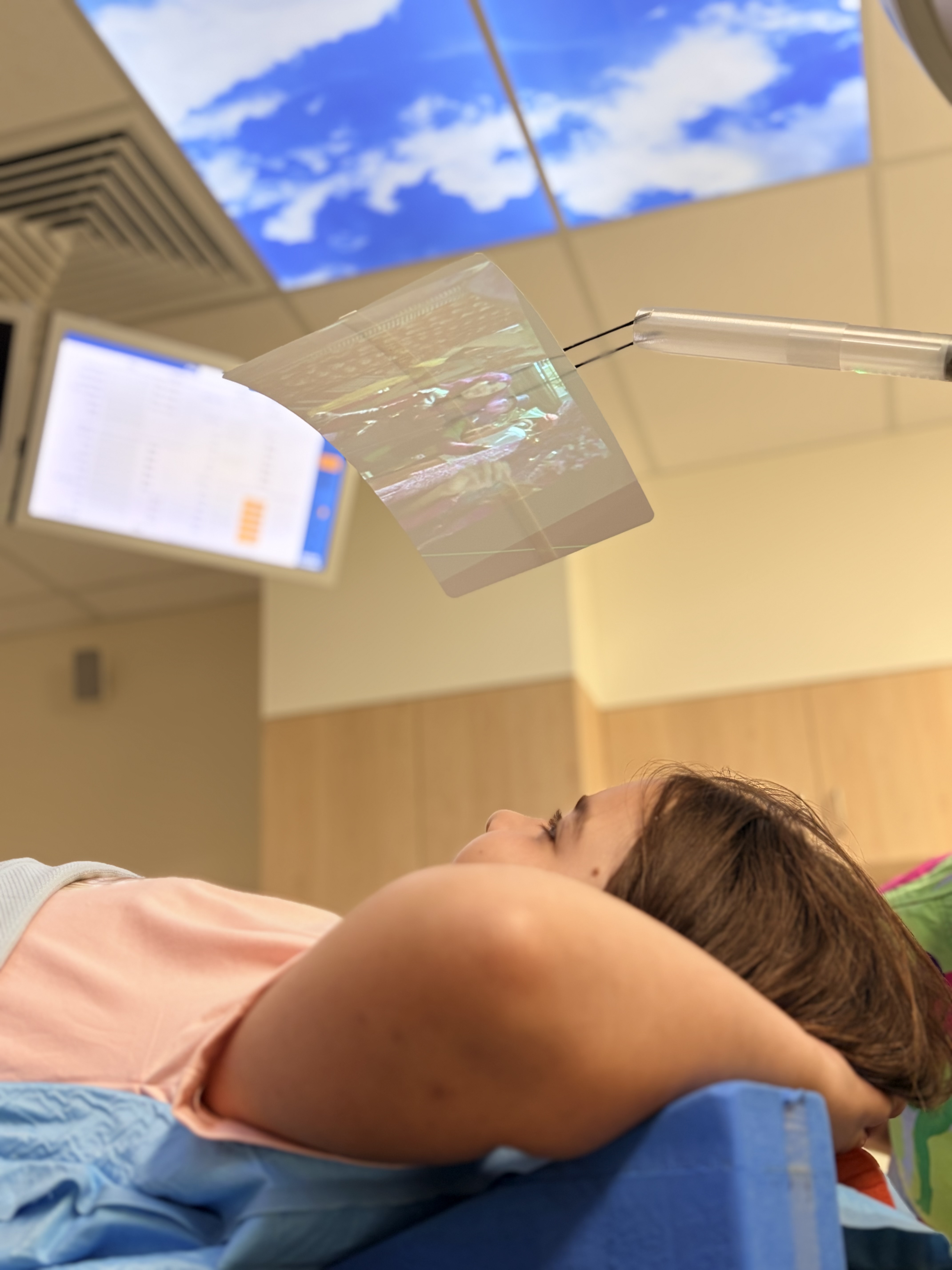
SPARK patient Connie Duggan could relax through her radiation treatment.
"It helped a lot to calm her down, especially with the brand-new experience of going through radiation," Jess said.
"If she had to be put under a general anaesthetic every day it would have been a lot more terrifying for her because she's absolutely petrified of needles.
"Once the initial fear of being diagnosed with cancer wore off, she's been absolutely resilient and faced everything with a smile on her face.
"SPARK has helped so much because it's got that familiarity of home, where she gets to sit down and watch one of her shows and it just brings some normality into such a sterile crisis.
"Everyone here treated her like a star all the way through. They remembered her favourite movies, her favourite music – so it was like she was just coming to see family or friends."
Senior Radiation Therapist and Senior Research Coordinator in Radiation Oncology, Narelle Wallace, said improving the patient and family experience was the driving force behind the project.
“As radiation therapists, we see firsthand how challenging treatment can be for young children,” Ms Wallace said.
“Many required a general anaesthetic every day for several weeks of treatment because remaining still can be difficult, especially if they are frightened.
“By reducing the need for daily general anaesthesia in suitable patients, SPARK has benefited everyone.
“Children avoid repeated anaesthetics, families experience less stress, and treatment days become simpler.
“It also frees up valuable anaesthetic resources, allowing those services to be available for other patients who need them.”
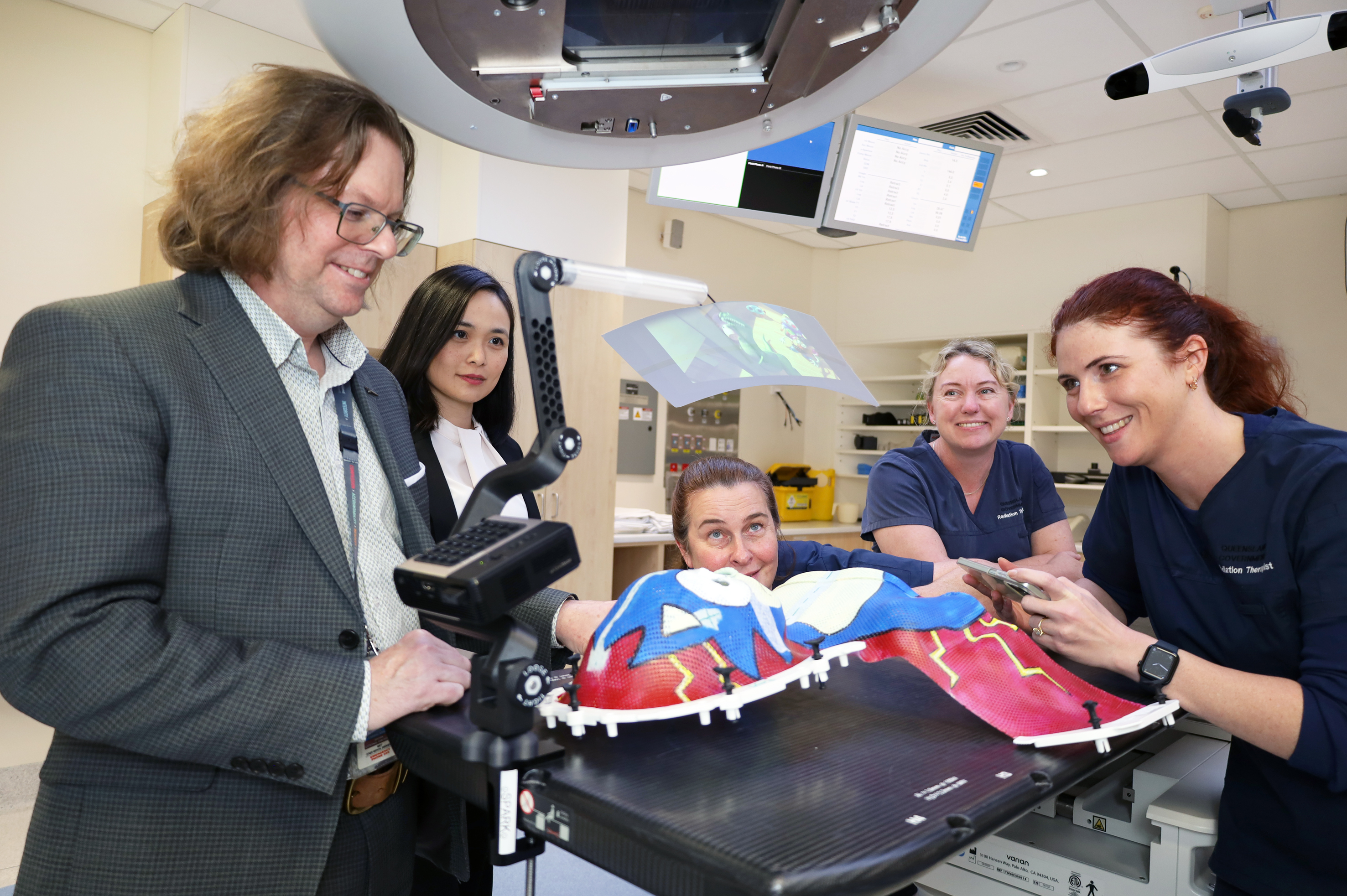 The team bringing SPARK to life: paediatric radiation oncology consultant specialist Dr Andrew Pullar, Medical Physics Research Consultant Lucy Sim, Senior Radiation Therapist Narelle Wallace, Radiation Therapist Jodi Mitchell and Radiation Therapist Senior Aimee Welch.
Expanding its range of potential benefit, the SPARK system has also been used to assist a hearing-impaired patient by providing visual breath-hold instructions during radiation treatment.
Additionally, the team is exploring multilingual translation to improve accessibility for patients from non-English-speaking backgrounds.
As a multidisciplinary collaboration involving radiation therapists, radiation oncologists and medical physicists, Ms Wallace said the smiles on children’s faces and the relief in parents’ eyes demonstrated why innovations like SPARK are so important.
“SPARK is a wonderful example of what can be achieved when clinicians, researchers and technical experts work together with a shared goal of improving patient care,” she said.
“I am incredibly proud of what our team has accomplished, but most importantly, I'm proud of the difference it has made for children and their families.”
SPARK was co-developed in partnership with Cosmo Huxley of PolyMed Technologies, with funding support from Tour de Cure through the Queensland Children’s Hospital and the Princess Alexandra Hospital Research Foundations.