

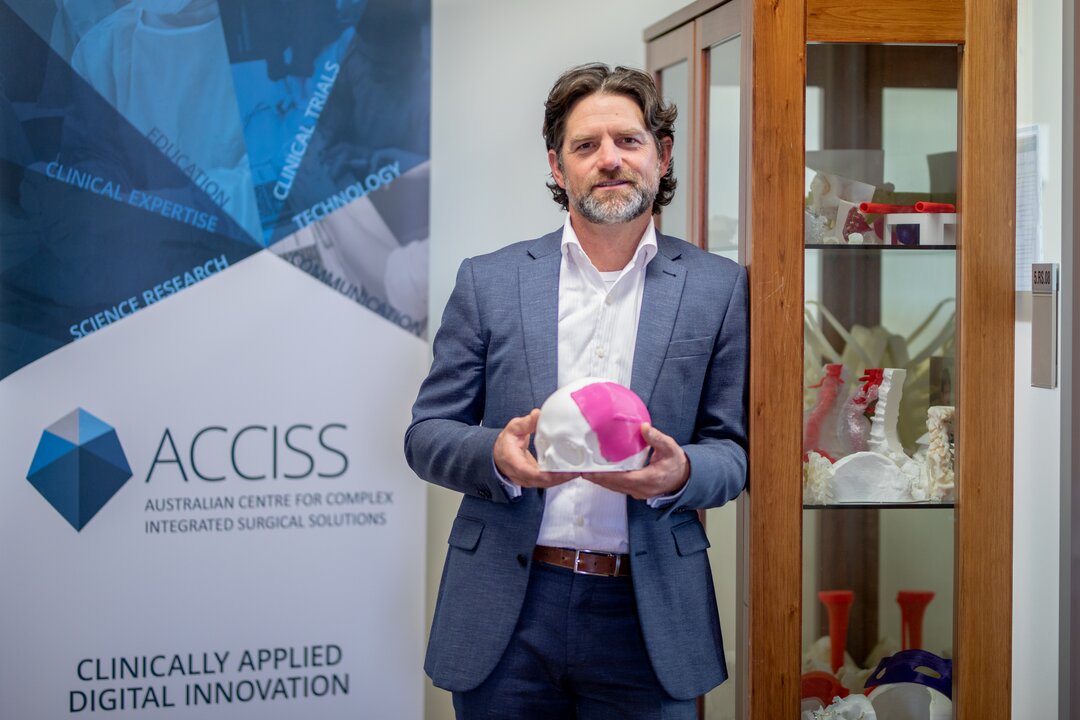
Dr Michael Wagels is the director of the Australian Centre for Complex Integrated Surgical Solutions and the Herston Biofabrication Unit.
Imagine being in a hospital, needing a rare, high-stakes procedure where a clinician must cut into the front of your throat to create an emergency airway and save your life.
Or consider delicate eye surgery requiring a precise anaesthetic injection behind your eye, so close to vital structures that a slight misstep could permanently affect your vision. While this procedure is performed more routinely, opportunities for hands-on training are scarce.
Both scenarios demand exceptional skill and precision. Yet one occurs so infrequently that even experienced clinicians may only perform it a handful of times in their careers, while the other is common enough to be expected, but rarely taught in depth.
To address these challenges, Queensland Health’s Herston Biofabrication Institute (HBI) and the Australian Centre for Complex Integrated Surgical Solutions (ACISS) are manufacturing lifelike training models, such as human throats or eye sockets.
These models enable clinicians to rehearse complex, high-risk procedures such as cricothyroidotomies* or periocular anaesthesia injections**.
At Brisbane’s Princess Alexandra Hospital and the Royal Brisbane and Women’s Hospital, Point-of-Care manufacturing centres such as ACISS and HBI enable biomedical engineers and designers to produce these 3D-printed training models.
Additionally, using patient-specific MRI and CT imaging data, these teams create medical devices that assist surgeons in planning and rehearsing complex procedures. These are provided as an anatomically accurate, 3D replicas of the patient’s body part that requires surgical treatment.

Eye anaesthesia requires careful skill from clinicians. The above training model at the Herston Biofabrication Institute replicates delicate ocular structures that specialists must navigate for safe, effective anaesthetic delivery.
For example, a 3D mandible (jaw) replicated from a patient’s CT scan can guide a surgeon in preoperative planning, allowing for precise reconstruction, implant fitting, and reduced time in the operating room.
This improved surgical accuracy enables surgeons to perform more precise procedures, which ultimately reduces errors and complications, resulting in better outcomes for patients.
“Clinicians can use these models and devices to better visualize and measure complex issues,” Director of HBI and ACCISS Dr Michael Wagels says.
“For example, if a surgeon needs to remove a tumour, we can design and produce model guides that precisely indicate where to make incisions, even if the tumour itself is not visible.”
Dr Wagel’s team is also developing bioactive, bio-resorbable implants that adapt to patients’ bodies and gradually dissolve.
“We’re working on implants that are replaced by the patient’s own tissue over time,” Dr Wagels says.
“This is especially promising for patients with large bone defects or those recovering from breast cancer treatments.
“Currently, if a patient has a large bone defect, we often have to take bone from another area, which creates a new challenge.
“Using bio-resorbable implants can reduce the complications associated with these treatments, giving patients a better quality of life.”
By combining medical imaging, 3D printing, and biomedical engineering, these centres are giving surgeons access to the tools they need to perform surgeries with greater accuracy and confidence.
The result is not only improved clinical capability but also safer surgeries, faster recoveries, and better outcomes for patients across Queensland.
* Cricothyroidotomy
A cricothyroidotomy is a surgical procedure performed in critical situations to quickly establish an emergency breathing route when conventional methods like intubation or ventilation have failed or are not feasible.
** Periocular anaesthesia injections
Periocular anaesthesia injections are used to numb the area around the eye by administering local anaesthetic into surrounding tissues. This targeted approach blocks pain and restricts eye movement during specific ophthalmic procedures.