

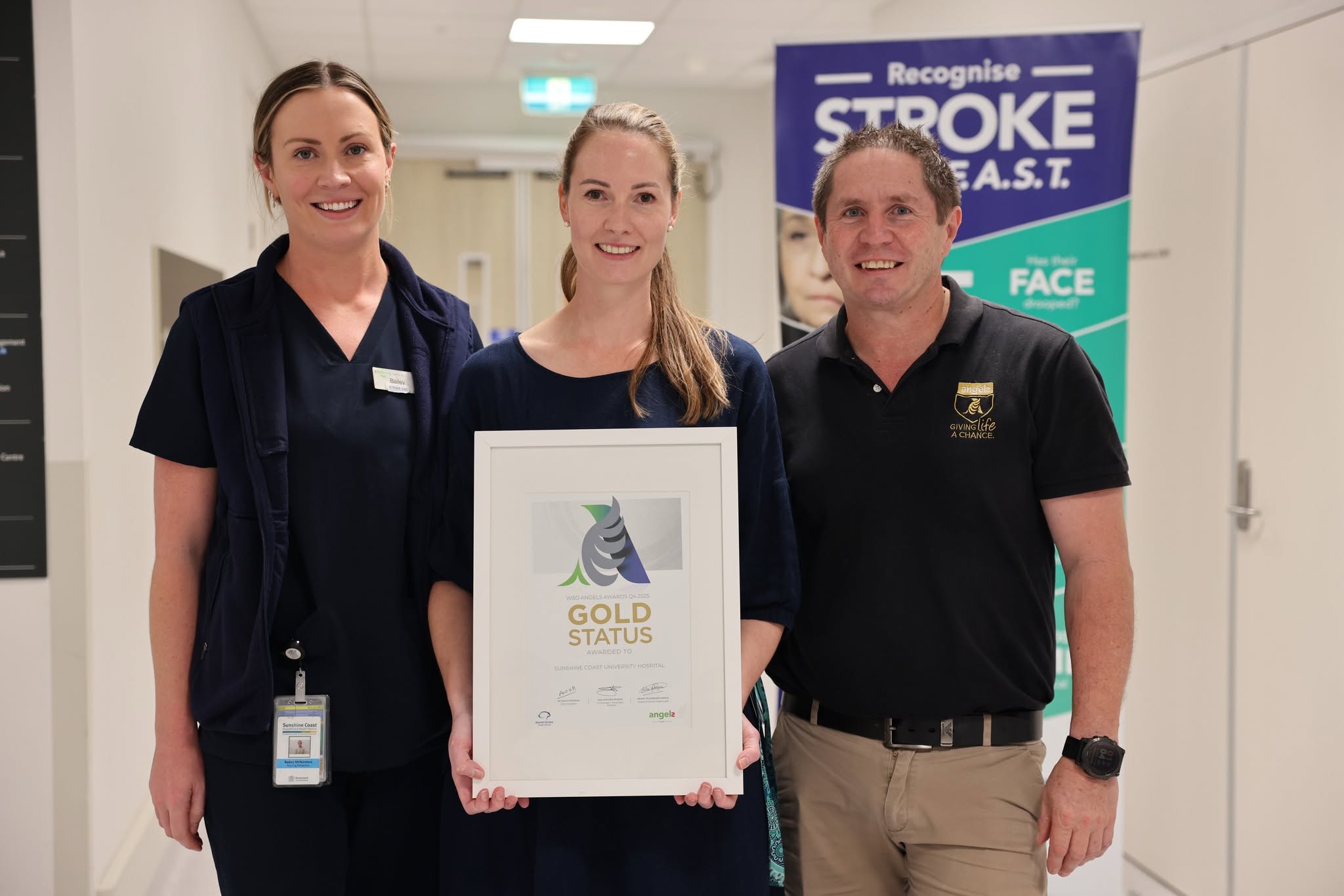
The Sunshine Coast University Hospital stroke team, including Bailey McNamara, Jess Pyman and Robert Hopkinson, were recently recognised with a GOLD Status Award from the World Stroke Organisation Angels Awards
Sunshine Coast’s Dru Arnold is one of the lucky ones.
The healthy and active 39-year-old was working his job as a concreter one day, and the next, was in hospital after having multiple strokes.
Dru said he remembers having a slight slurring of speech at work and later a massive headache, when he decided to call it a day – what he didn’t realise is that he was having a stroke.
Unbeknownst to Dru, overnight he suffered another two ministrokes.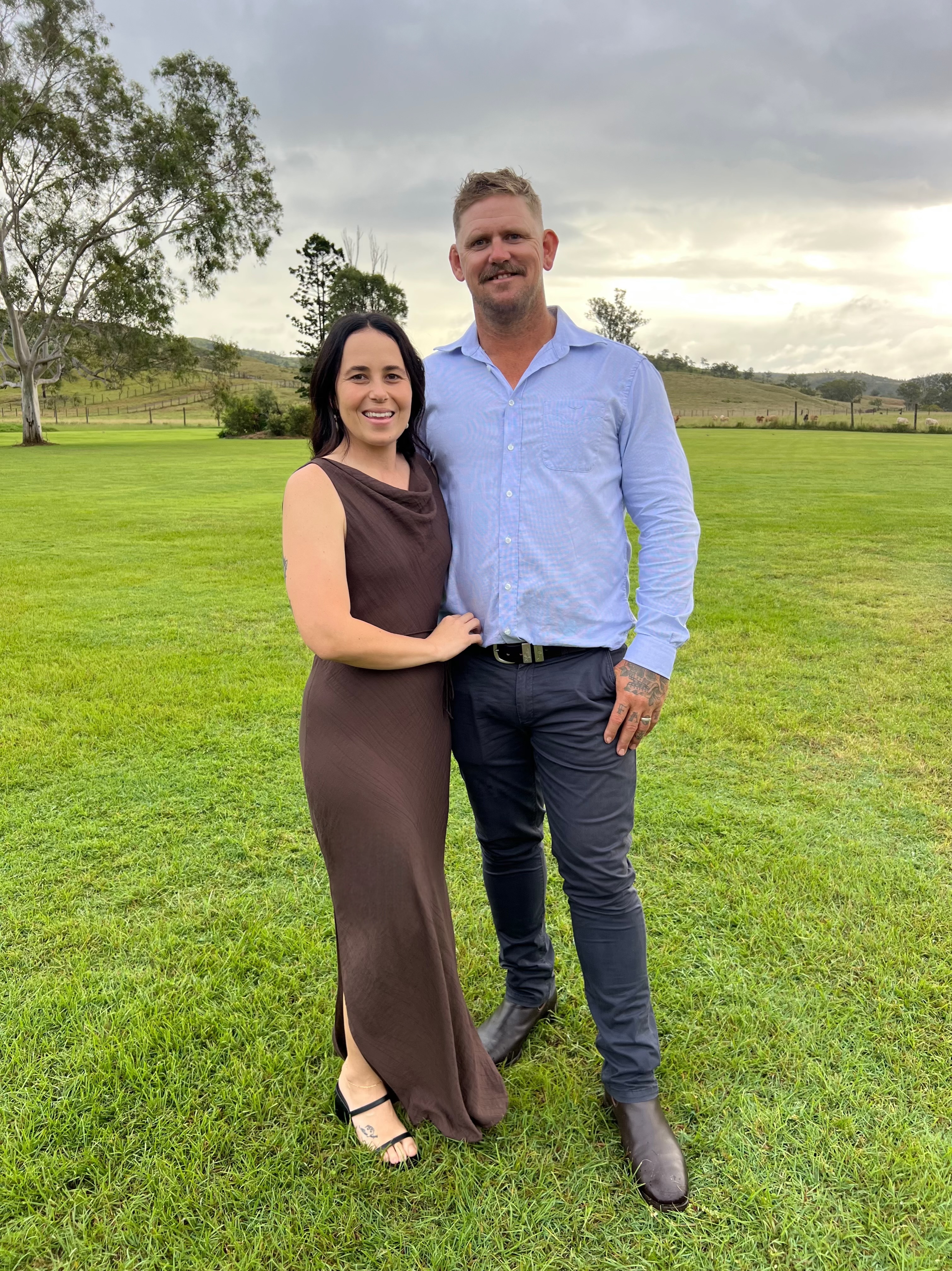
“I woke up the next day feeling fine, so I had brekky and washed the car,” he said.
“A bit later, I spoke to my wife on the phone, and she said my speech had worsened, so she called an ambulance immediately and I was taken to Sunshine Coast University Hospital.”
Dru had thought he was fine all day, not suspecting he was having a stroke. It was only when he was taken to hospital that he said it felt more “real and scary”.
“I was quite emotional and seeing my wife and brother beside me in tears made it worse; but I’m glad I had them,” Dru said.
“I was there for three days being monitored and the next week after that I was in intensive rehabilitation and on my way to recovery.”
Now more than seven months since his stroke, Dru’s life has almost got back to normal.
“I’ve found a few things are different but not a great deal. I’ve mostly gained my speech, and memory back, and can still feel fatigued, however, over time I think I’ll make a 100 per cent recovery.”
He said people should be aware of the symptoms and that no one was too young to have a stroke.
“To be honest, I didn't know the signs of having a stroke such as a headache, brain fog, slurry speech and having trouble moving limbs like they should.
“I'm proof you’re never too young, and there are a lot of people younger than me who have suffered a lot worse.”
Dru credits his recovery to the stroke team at Sunshine Coast University Hospital.
“I can’t thank them enough and all the staff they were brilliant and very comforting and really prepared and professional with everything,” he said.
“It was the first time I had really been to a hospital for something serious in my life and they went above and beyond in the care they provided. The rehab team were undeniably the best ever and if it wasn't for them I would not have had the confidence to push on like I did.”
Leading the way in stroke careThe amazing work of the SCUH stroke team was recently recognised winning a GOLD Status Award from the World Stroke Organisation Angels Awards.
Stroke Clinical Nurse Consultant Bailey McNamara credited the win to the devoted team of experienced neurologists, registrars, a Stroke Nurse Practitioner, Stroke Clinical Nurse Consultants, nursing staff, admin and allied health.
“We all manage the patient journey in different ways; however, we all have the same common goal to work collaboratively with the patient and their family, whilst providing comprehensive care guided by evidence-based practice to ensure they receive the best support during their time at Sunshine Coast University Hospital,” Bailey said.
The Gold status award recognises their commitment to quality stroke care by comparing data to seven criteria points.
“One point that contributed to us receiving the award was our high achievement in ensuring patients receive timely hyperacute therapies such as thrombolysis, also known as clot busting medication, within 60 minutes of entering the emergency department,” she said.
“This aligns with the 30/60/90 National Stroke Targets which are benchmarks established to improve the speed and quality of stroke treatment, minimise brain damage, and increase survival rates.
“It's a fantastic way to let the community know that when they come to Sunshine Coast University Hospital that they're going to get timely, hyper acute treatments, within the recommended time frames, guided by national stroke targets.”
Anyone can be affected by stroke
Stroke ranks as the fourth leading cause of death in Australia and can affect anyone at any age.
In 2024 alone, stroke claimed 9,147 lives; on average, someone experiences a stroke every 11 minutes.
However, 80 per cent of strokes are preventable if healthy lifestyle choices are made and risk factors such as uncontrolled high blood pressure, cholesterol, irregular heartbeat and diabetes are managed to help significantly reduce a risk of stroke.
Know the signs of stroke
Bailey said the most critical factor for a patient from the onset of symptoms to receiving treatment is time.
“A lot of treatment for stroke can only be given within certain timeframes, so it is important that when people recognise stroke symptoms that they call 000 immediately,” she said.
“Stroke is a medical emergency; we use the saying ‘time is brain’ as we know that in every minute that goes untreated, the brain loses up to 1.9 million neurons which can be detrimental in a person's recovery.”
What is a stroke? Stroke occurs when an artery supplying blood to a part of the brain suddenly becomes blocked or bleeds. This can damage part of the brain, which in turn impairs a range of functions including movement of body parts and communication. The effects depend on which part of the brain was targeted and how severely. A person who suffers from a small stroke may recover, while a larger stroke can lead to permanent disabilities. Signs of a stroke
|