

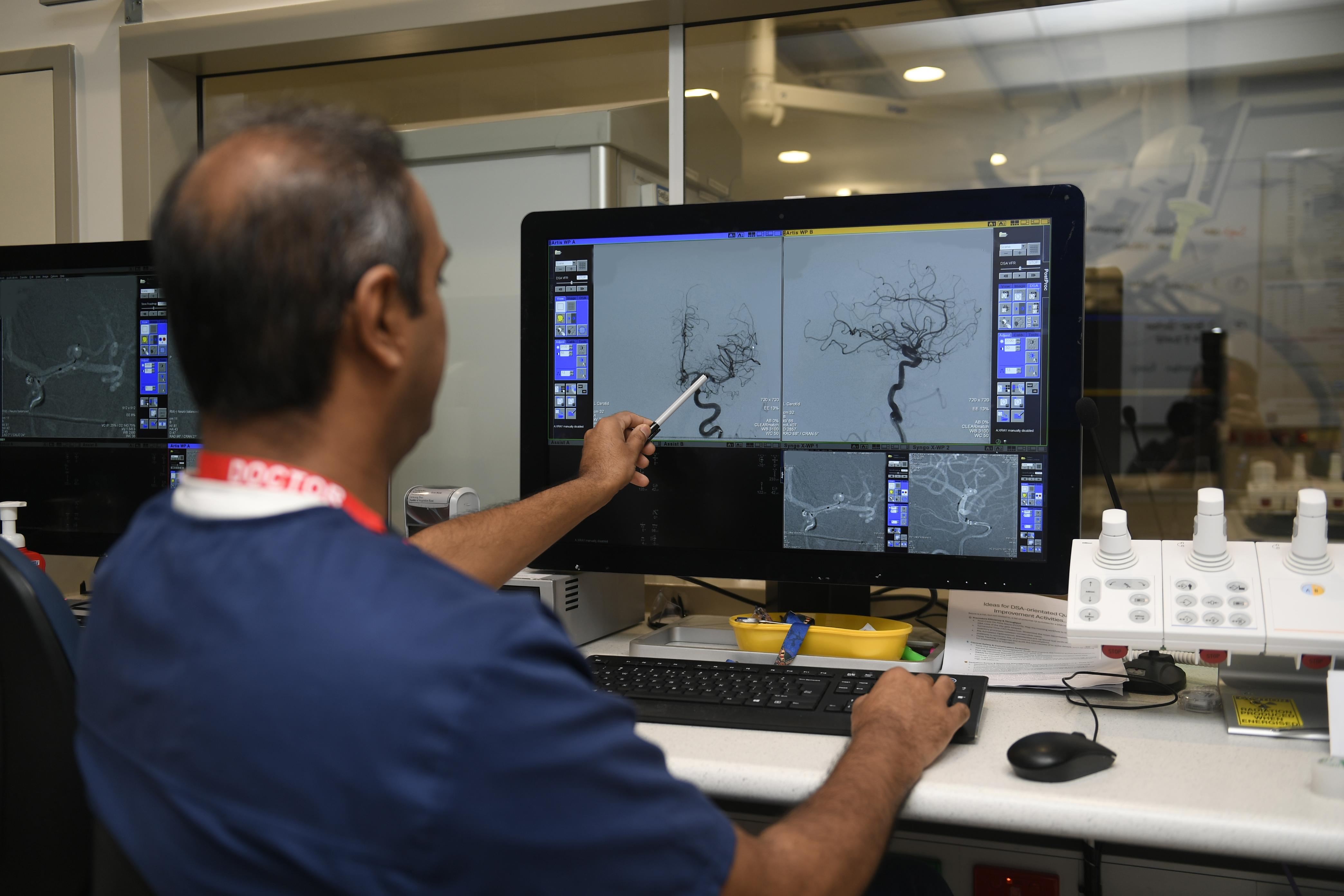
Interventional Neuroradiology Staff Specialist Dr Usman Manzoor.
When every second counts, access to stroke specialists can mean the difference between life, disability, or death.
A stroke occurs every 11 minutes in Australia, and Queenslanders are hit particularly hard (Stroke Foundation).
Our state accounts for nearly 20 per cent of all cases nationwide, with more than 9,000 Queenslanders suffering a stroke each year (Stroke Foundation).
Today, almost 89,000 stroke survivors live across Queensland, many with ongoing disabilities.
The Queensland Telestroke Service (QTS), backed by the government’s $5.8 million investment, is working to change that by giving regional and remote patients rapid access to specialist stroke care.
To deliver this care, QTS, based at the Royal Brisbane and Women’s Hospital, works closely with Queensland’s four existing Comprehensive Stroke Centres to provide urgent, time-sensitive interventions across regional and remote communities.
So far, it is dramatically improving patient outcomes, returning patients to how they were before their stroke.
QTS in North Queensland
Townsville University Hospital (TUH) is one of the four Comprehensive Stroke Centres in Queensland working in partnership with RBWH QTS.
They support patients from Rockhampton to Cape York and west to Mount Isa, enabling faster, life-saving treatment across Central, Western and Northern Queensland.
Queensland Telestroke Service Clinical Director Associate Professor Carlos Garcia-Esperon said that QTS allows neurologists to connect with rural clinicians via video and assess brain imaging scans in real time.
“Having that direct, immediate access to the patient, their scan, and rural clinicians means together we can provide rapid treatment decisions, including whether a patient needs urgent helicopter transfer to TUH,” Associate Professor Garcia-Esperon said.
“It’s this critical collaboration between regional hospitals and QTS that makes all the difference to patients and their outcomes.
“It also means people in regional, rural, and remote communities now have the same 24/7 access to stroke specialists as those in metropolitan centres.”
TUH Acting Clinical Director of Neurology Dr Ravindra Urkude said the speed of treatment has truly transformed outcomes.
“When someone suffers a stroke, ever second counts,” Dr Urkude said.
“Brain cells begin to die the moment blood flow is blocked. Acting quickly can mean a patient returns to baseline, essentially a full recovery.
“QTS means people in regional, rural, and remote communities now have the same 24/7 access to stroke specialists as those in metropolitan centres.”
According to a 2021 report by the Stroke Foundation, regional Australians are 17 per cent more likely to experience a stroke than people in metropolitan areas, making timely diagnosis and treatment even more critical.
Dr Urkude said many regional areas previously had no rapid access to stroke services.
“Before QTS, patients from northern Queensland were often transferred to the Gold Coast University Hospital, a journey too long for many to remain eligible for lifesaving procedures,” he said.
“By the time they arrived, the window for intervention had closed as the brain had suffered too much damage.
“A fast transfer is essential.”
Since QTS began, TUH has gone from supporting around 20 regional patients a year to more than 120 today, achieving a sixfold increase.
The service has supported patients from ages 19 to 93, and every age in between.
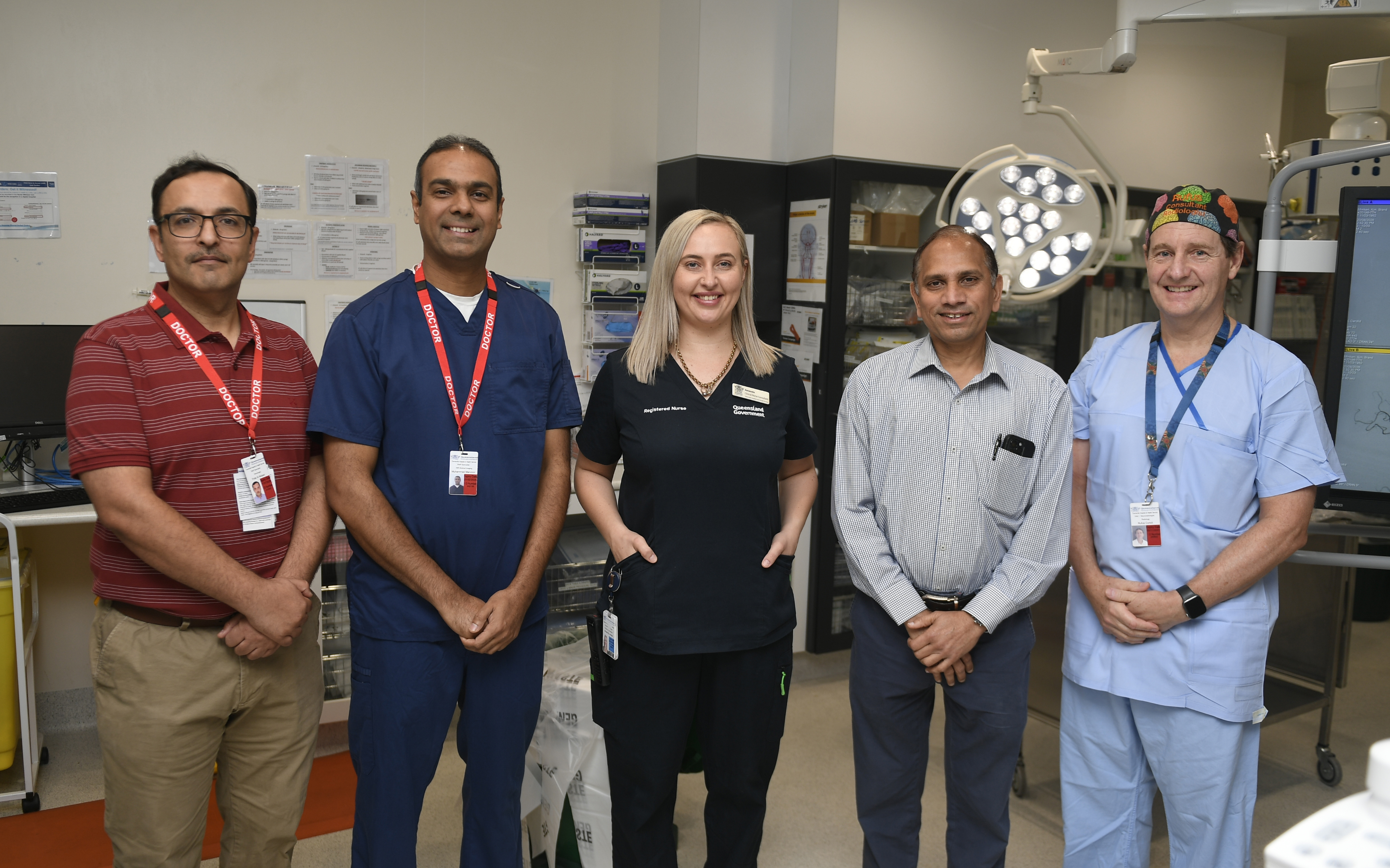
Townsville University Hospital Telestroke clinicians (L-R) Dr Firas Al-Nidawi, Dr Muhammad Usman Manzoor, Amanda Hannah, Dr Ravindra Urkude, and Dr Rufus Corkill.
Standardised care and faster transfers
TUH Interventional Neuroradiology Staff Specialist Dr Usman Manzoor said QTS has unified and streamlined care across the north.
“Clinicians no longer need to work out who’s on call. There’s one number, one pathway, and consistent care for our entire region,” Dr Manzoor said.
“Transfers are faster, and even hospitals without onsite neurology can assess patients over telehealth and receive immediate specialist guidance.”
He recalls a 43-year-old Mackay mother of two who made a full recovery thanks to rapid imaging, Telestroke assessment, and an urgent transfer to Townsville.
“She was a completely different person only hours after her procedure. She’s now back to her family, back to work.”
New technology transforming outcomes
Access to CT brain perfusion imaging is also changing the game.
Now available in more regional hospitals, these scans look at the brain blood flow through the main vessels to help doctors tell permanently damaged tissue apart from living tissue that can still be saved during a stroke.
“Perfusion imaging tells us who will benefit from transfer and intervention,” Dr Manzoor said.
“Without it, you risk a futile transfer. With it, almost 60 per cent of patients can return to their baseline level of function if treated in time.”
He said recognising symptoms quickly remains vital.
“People can be working, talking to friends, and suddenly everything changes. Time is the most important factor.
“Every minute counts because every minute more brain cells die.”
Expanding QTS across Queensland
Queensland Telestroke Service is currently live across ten Queensland sites: Hervey Bay, Bundaberg, Ipswich, Mackay Base, Toowoomba, Kingaroy, Rockhampton, Bowen, Proserpine, and Gladstone hospitals.
There are additional rollouts planned through until 2028.
With continued investment and expansion, Telestroke is ensuring that no matter where a stroke occurs in Queensland, lifesaving specialist care is only moments away.
Spot the signs, save a loved one
Learning to spot a stroke can save someone you love. When a stroke strikes, every second counts—acting fast makes all the difference.
Follow BE FAST:
- Balance: Loss of balance, dizziness
- Eyes: Sudden trouble seeing
- Face: Has it drooped?
- Arms: Can they be raised?
- Speech: Is it slurred or confused
- Time: is critical - call Triple Zero (000) immediately.