

Queensland Health 2026 Influenza vaccination advice
The 2026 Queensland Free Flu Vaccination Program concluded on 30 September 2026.
Free influenza vaccine remains available through the National Immunisation Program (NIP) for eligible people.
Annual influenza vaccination is the best way to protect against severe disease and complications from influenza. The Australian Technical Advisory Group on Immunisation (ATAGI) recommends influenza vaccination for all people aged 6 months and over.
In 2026, all Queenslanders aged 6 months and over are eligible for free influenza vaccination under the 2026 Queensland Free Flu Vaccination Program.
Administration
The ATAGI statement on the administration of seasonal influenza vaccines in 2026 details all brands of influenza vaccine registered for use in Australia. Vaccination providers should refer to this statement along with the Australian Immunisation Handbook and the Immunisation Schedule Queensland prior to administering any influenza vaccine.
Vaccine strains
Influenza vaccines are updated annually to address the most common circulating strains.
The 2026 trivalent seasonal influenza vaccines* for the southern hemisphere include both egg and cell-based strains:
Egg-based influenza vaccines | Cell-based influenza vaccines |
|---|---|
A/Missouri/11/2025 (H1N1) pdm09-like virus | A/Missouri/11/2025 (H1N1) pdm09-like virus; and |
A/Singapore/GP20238/2024 (H3N2)-like virus | A/Sydney/1359/2024 (H3N2)-like virus |
B/Austria/1359417/2021 (B/Victoria lineage)-like virus | B/Austria/1359417/2021 (B/Victoria lineage)-like virus |
*Note: The chosen egg-based and cell-based viruses will sometimes differ if one virus cannot be used for both production systems. In this case, different vaccine viruses with similar properties are selected for vaccine production.
Australia has transitioned from using quadrivalent influenza vaccine (QIV) to trivalent influenza vaccine (TIV) formulations for influenza immunisation in line with recommendations from Australian Influenza Vaccine Committee.
In 2026, all NIP-funded influenza vaccines available are trivalent vaccines (TIV) including the adjuvanted (enhanced) influenza vaccine for adults aged 65 years and older.
Timing of influenza vaccination
Influenza is highly contagious and can circulate year-round. Infection rates tend to increase during the cooler months between May and October with the peak commonly occurring in August. In tropical areas, the pattern can be more variable and may include clusters outside this period.
Annual vaccination should ideally occur before the onset of each influenza season. Vaccinating from April provides protection before the expected infection peak. While protection is generally expected to last for the whole season, the best protection against influenza occurs within the first 3 to 4 months following vaccination.
If a person had a 2025 formulation of the influenza vaccine in late 2025 or early 2026, they are still recommended to receive the 2026 formulation influenza vaccine when available.
It is never too late to be vaccinated since influenza can circulate in the community all year. Vaccination should continue to be offered while a non-expired vaccine is available.
Influenza vaccination during pregnancy and for international travellers can be of benefit at any time of year.
It is also important to remind people that the vaccine is not immediately effective, and it generally takes 10 to 14 days to be protected.
Co-administration with other vaccines
People can receive influenza vaccines at the same time as most other vaccines, including dTpa, RSV, pneumococcal and COVID-19 vaccines. Refer to the Australian Immunisation Handbook for more information.
Australian Immunisation Register
It is mandatory under the Australian Immunisation Register Act for providers to record all influenza vaccinations administered to the Australian Immunisation Register (AIR). Further information can be found on the Australian Government Department of Health and Aged Care website.
Influenza vaccine safety
Contraindications: The only contraindications to influenza vaccines are:
- Anaphylaxis following a previous dose of any influenza vaccine.
- Anaphylaxis following any vaccine component (excluding eggs).
Egg allergy: People with egg allergy, including a history of anaphylaxis, can be safely vaccinated with any influenza vaccines (including egg-based and cell-based vaccines) unless they have reported a serious adverse reaction to influenza vaccines. Refer to the Australian Immunisation Handbook for more information on vaccinating people with a known egg allergy and vaccination for people who have had an adverse event following immunisation.
Latex allergy: The influenza vaccines available under the NIP in 2026 are latex free and people with a latex allergy can safely be vaccinated.
For all other influenza vaccines refer to the Australian Immunisation Handbook or the respective Product Information.
Adverse events following vaccination: Under the Public Health Act 2005, adverse events following immunisation (AEFI) are a notifiable condition. Notification of all AEFIs at any age should be made by submitting an Adverse Events Following Immunisation Reporting Form. Any person can report an AEFI including clinicians, the immunised person or family members.
Vaccine administration errors: VAEs may occur due to errors in vaccine preparation, handling, storage, or administration, but also encompasses immunisation error-related reactions .
Identification and follow-up of VAEs can identify and correct immunisation error-related reactions in a timely manner and is essential to ensuring the quality and safety of a vaccination service.
- All VAEs must be notified by submitting a Vaccine Administration Error Reporting Form
- Any VAE that has resulted in an AEFI must be reported to Queensland Health using the Adverse Events following Immunisation reporting form
Eligibility for influenza vaccines funded by the National Immunisation Program
Annual influenza vaccination is recommended for all people from 6 months of age. Influenza vaccines are funded under the National Immunisation Program (NIP) for the following groups:
- Children aged 6 months to less than 5 years.
- People aged 65 years or over.
- Aboriginal and Torres Strait Islander people aged 6 months and over.
- During Pregnancy at any stage.
- People aged 6 months and over who have a medical condition that is associated with an increased risk of influenza disease complications. A list of these conditions and associated NIP funding is available in the Australian Immunisation Handbook.
Age restrictions apply to all influenza vaccine brands. Please refer to the Australian Technical Advisory Group on Immunisation (ATAGI) clinical advice statement.
2026 Free Flu Vaccination Program
Commencing 1 March 2026, all Queenslanders will be able to access free influenza vaccination. For more information on this program, including reimbursement available to providers, refer to the 2026 Free Flu Vaccination Program webpage.
2026 Queensland Nasal Spray Flu Immunisation Program
In 2026 all Queensland children aged 2 to 5 years (inclusive) and children aged 6 to 17 years (inclusive) who struggle with getting a needle are eligible for the nasal spray influenza vaccine (FluMist).
The nasal spray influenza vaccine will be made available for free across Queensland, in general practices, pharmacies, Aboriginal and Torres Strait Islander Community Controlled Health Services and other community immunisation providers.
For more information on this program refer to the 2026 Queensland Nasal Spray Flu Immunisation Program webpage.
FluMist will also be available on the private market for children 6 to 17 (inclusive) who are not eligible for the funded program. State-funded stock should not be used for these children.
Aboriginal and Torres Strait Islander peoples
The disease burden from influenza is significantly higher among Aboriginal and Torres Strait Islander peoples than for non-Indigenous Australians in all age groups. Influenza vaccination is recommended and funded under the NIP for all Aboriginal and Torres Strait Islander peoples from 6 months of age.
Children
Children aged 6 months to less than 5 years are at increased risk of complications from influenza. Even healthy children susceptible to severe illness. The influenza vaccine is recommended and funded under the NIP for all children in this age group.
When receiving an influenza vaccine for the first time, healthy children aged 6 months to less than 2 years, and those with a medical risk condition aged 6 months to less than 9 years should receive two doses, given 4 weeks apart. One annual dose of influenza vaccine is required in following years even if only one dose was given in the first year.
Refer to the Australian Technical Advisory Group on Immunisation (ATAGI) clinical advise statement and the Australian Immunisation Handbook Influenza chapter for further information on children who are receiving influenza vaccine for the first time.
Medically at Risk
Influenza vaccination is particularly important for people with underlying medical conditions as they are at high risk of complications from influenza.
Influenza vaccine is recommended and funded under the NIP for all people aged 6 months and over with certain medical conditions. A list of these conditions is available in the Australian Immunisation Handbook.
Children aged 6 months to less than 9 years with a medical risk conditioning receiving influenza vaccine for the first time should also receive two doses, given 4 weeks apart.
Refer to the Australian Technical Advisory Group on Immunisation (ATAGI) clinical advice statement and the Australian Immunisation Handbook influenza chapter for further information.
Vaccination during pregnancy
People who contract influenza during pregnancy have an increased risk of complications and a higher risk of preterm birth.
Influenza vaccination is recommended and funded under the NIP at any stage of pregnancy. It should be offered as part of routine antenatal care. Vaccination during pregnancy also protects infants from influenza in the first 6 months of life, when they are too young to be vaccinated against influenza.
People who received an influenza vaccine in 2025 are also recommended to receive the 2026 influenza vaccine if it becomes available before the end of their pregnancy. Those who received influenza vaccine before becoming pregnant should be revaccinated during pregnancy to protect the unborn infant.
Influenza vaccine can safely be administered during pregnancy at the same time as the pertussis, RSV, and COVID-19 vaccines, as well as anti-D immunoglobulin.
Pregnant women and pregnant people should receive inactivated influenza vaccine only. As a precaution, Live Attenuated Influenza Vaccine (LAIV) should not be administered during pregnancy.
People 65 years and older
Vaccination is particularly important for people in this age group as they are at high risk of complications from influenza. Influenza vaccination is recommended and funded under the NIP for all people aged 65 years and over.
Fluad®, the adjuvanted influenza vaccine, is recommended in preference to standard influenza vaccine for adults aged 65 years and over.
In 2026 the following influenza vaccines are funded
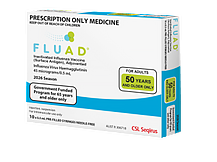
| Fluad® | NIP funded for all people aged 65 years and over Adjuvanted influenza vaccine DO NOT USE THIS VACCINE FOR ANY OTHER AGE GROUP |
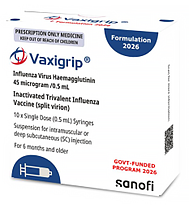
| Vaxigrip | NIP funded for eligible cohorts aged 6 months to less than 65 years |
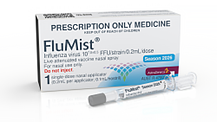
| FluMist | State funded for - |
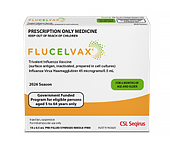
| Flucelvax® | NIP funded for at risk persons aged 5 years to less than 65 years |
Download the 2026 Flu vaccine poster (PDF 3189 kB)
Educational videos for providers
- Administration of influenza virus vaccine nasal spray to young children
- Administration of influenza virus vaccine nasal spray to older children and adolescents (<18 years of age)
Influenza vaccine ordering, storage and handling
Immunisation service providers registered with the Queensland Health Immunisation Program (QHIP) can order NIP funded influenza vaccines through QHIP. For more information visit Order, store and manage immunisations.
Influenza vaccines that are available on the private market should continue to be accessed through pharmaceutical wholesalers.
Correct vaccine storage and handling processes play an important role in protecting individuals and communities from vaccine-preventable diseases. For general recommendations and guidance, refer to the National Vaccine Storage Guidelines 'Strive for 5'. For Queensland Health specific information visit the Cold chain breaches | Queensland Health webpage.
More information
- ATAGI statements | Australian Government Department of Health, Disability and Ageing
- Influenza (flu) | The Australian Immunisation Handbook (health.gov.au)
- Adverse event following immunisation and vaccine administration errors.
- 2026 Queensland Nasal Spray Flu Immunisation Program
- 2026 Free Flu Vaccination Program
- Using the Australian Immunisation Register (AIR) | Queensland Health
- Influenza immunisation resources | NCIRS
For more information contact immunisation@health.qld.gov.au