

First Nations Palliative Care
Aboriginal and Torres Strait Islander people should be aware that this page may contain images, voices and names of deceased persons.
The First Nations Palliative Care project is hosted by the Aboriginal and Torres Strait Islander Health Service, Metro North Health. The project:
- aims to improve capacity to meet the palliative and end-of-life care needs of First Nations Queenslanders
- seeks to increase culturally safe, evidence-based and responsive services across the health sector for First Nations Queenslanders
- leads First Nations palliative care delivery by enhancing and developing culturally appropriate resources and tools with a focus on workforce, education and systems development designed with and for First Nations Queenslanders
- does not provide direct care to patients and family care but supports frontline clinicians and builds workforce capability and capacity.
PallConsult is proud to work collaboratively with the project, the First Nations Health Office and First Nations health professionals across the state to support quality palliative care for all First Nations people.
Resources to support First Nations people
Yarning about morphine
The Yarning about morphine brochure answers common questions about morphine.
Yarning about morphine is important for seriously sick people, their families and community. Sometimes, people may feel worried about taking morphine. Health professionals can use this brochure to guide discussions with First Nations people and their families.
Download the Yarning about morphine brochure (PDF 5069 kB)
Advance care yarning
Tailored resources are available to support advance care yarning with First Nations Queenslanders
Advance care yarning, also known as advance care planning, is the process of letting others know what you want for your future and ongoing health care. It can mean:
- thinking, talking and deciding about what matters to you
- letting others know your wishes, values, beliefs and choices
- knowing your family and healthcare staff will have the information needed to respect your choices, your way, when you cannot speak for yourself.
Health professionals can use these resources to support culturally appropriate conversations about future health care.
Brochure
Printed copies of this brochure can be ordered via WINC – SW1262 Advance Care Yarning brochures (50 pack).
Download the Advance care yarning brochure (PDF 2201 kB)
Videos
- Video 1 – Advance Care Yarning. Your Care, Your Choice, Your Belonging
- Video 2 – Advance Care Yarning. Forms to support you
- Video 3 – Advance Care Yarning. A Family Story
Statewide Clinical Yarning Circle
The Statewide Clinical Yarning Circle provides leadership and collaborative education to Aboriginal and Torres Strait Islander health professionals about end-of-life care for adults and children. Topics are guided by clinical specialists.
The Yarning Circle is suitable for First Nations health professionals working across hospital, community, children’s health, aged care and allied health settings in Queensland.
For more information about the Statewide Clinical Yarning Circle, email Kat.Hooper@health.qld.gov.au or phone (07) 3170 4460.
Advance Care Yarning Art Competition
The Advance Care Yarning Art Competition was held in 2024 with the theme My Care, My Choice, My Belonging.
First Nations Queenslanders were invited to submit original artworks exploring how advance care yarning and making future health care choices can support a positive health journey.
Thank you to everyone who entered, and congratulations to the first place and joint second place artists.
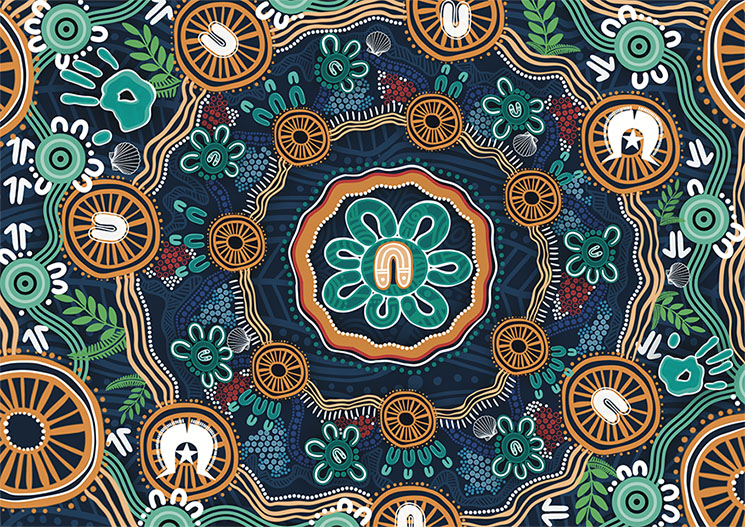
First place
Connected to Country and Family by Leah Cummins
"This story is inspired by our need to support our loved ones during their most difficult times and how community along with Country plays a role in healthy minds and healthy healing. In the heart of this intricate web of support stood the family, pillars of strength and beacons of unwavering love.
Surrounding the family and their loved one are pathways. These pathways having meeting places along the way where support of community and networks help assist in the healing journey of the loved one.
The hands are the helping hands there to support and showing care and love. The plants are the connection to Country. This is important in all First Nations health and wellbeing to be supported back on Country for the soul and spiritual connection to be rejuvenated."
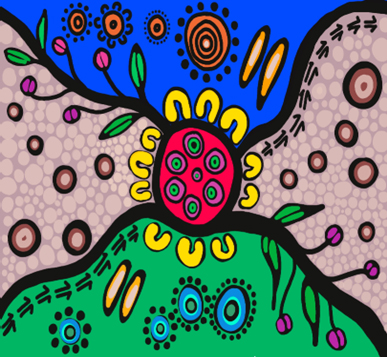
Joint second place
Yarning Circle by Lauren Rogers
"I celebrate the power of storytelling and knowledge-sharing in First Nations communities. The artwork features a yarning circle at the centre, symbolising community and connection, surrounded by kangaroo tracks, bush berries, and pebbles representing the land and culture.
Above, the sky, sun, stars, and clap sticks signify spirituality and cultural heritage. Water iconography twirls at the bottom represent the connection to life-giving water.
Through this artwork, I use bold colours to highlight the importance of advance care yarning and making choices for future health care that embrace spirituality, community, and connection to Country."
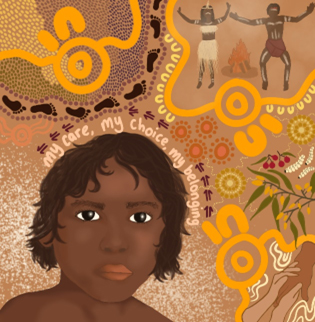
Joint second place
Cultural Healing by Birra-Li Warner
"This artwork represents the journey of connection to culture and Country. As First Nations people, being on Country, traditional dancing, bush tucker and yarning with mob heals our well-being. Connecting to culture and Country allows us to reflect on our spiritual, mental and physical health journey.
The young boy represents someone who is regaining strength through the mourning process using these connections.
The hands in this artwork show how important supporting and comforting a patient through their palliative care journey is."
Contact the First Nations Palliative Care Project team
Kat Hooper, First Nations Palliative Care Nurse Practitioner
Email: A_TSILT-PalliativeCare@health.qld.gov.au
Phone: (07) 3170 4460
In line with the PallConsult service model, the project is not a provider of direct care to patients and families. It is an indirect provider of care to families and communities through support for frontline clinicians and building capacity and capability.