

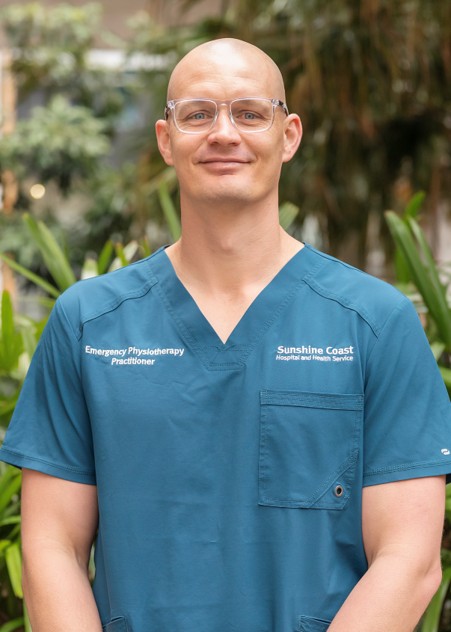
Richard works as an Emergency Physiotherapy Practitioner with the Emergency Department of Sunshine Coast University Hospital
Not many would have the stomach to pop dislocated joints back in place, but it’s one of many fulfilling tasks performed by the Emergency Physiotherapy Practitioners (EPP) at Queensland Health.
In his role in the Emergency Department (ED) at Sunshine Coast University Hospital (SCUH), EPP Richard works as an independent clinician as part of a multidisciplinary team, providing care and consultancy for musculoskeletal conditions and traumatic injuries.
It’s the sort of work you might see a doctor perform on TV - ordering and interpreting X-Rays, and procedures such as relocating dislocated joints and fractured bones, and applying casts. But the role extends far beyond that, Richard says.
EPPs are unique physiotherapists who function as independent practitioners within the ED.
The team is this week celebrating Allied Health Professions Day along with many others across Queensland Health.
In their advanced practice, EPPs are expert clinicians in the spectrum of musculoskeletal care.
They manage traumatic soft tissue injuries and fractures, acute orthopaedic care, and screening of more chronic musculoskeletal conditions and complaints for medical masquerades and red flag pathology.
Through their presence in the ED, EPPs help to both support their patients and to ease burden on medical and nursing colleagues to facilitate care of more critically ill patients.
“I am fortunate to work among a dynamic and collaborative team of emergency doctors, nurses, nurse practitioners, radiographers, social workers, occupational therapists, and many more,” Richard says.
“We work together to support patient flow and access to emergency care for the Sunshine Coast community.”
“You truly feel like you are part of a team working towards shared goals.
“I am also a strong believer that a healthy combination of autonomy, responsibility for your decisions and access to senior clinical support leads to happy and rewarded clinicians, and importantly, happy patients who receive best care.
“Working within emergency care offers this and more; I fell in love with this environment and have not looked back since.”
If a patient presents to an ED with a musculoskeletal injury or condition, it means they can be seen directly by an EPP as an expert clinician in a timely fashion.
“I truly enjoy the human side of working in an ED and the privilege to help patients at a time and place, which for some, could be the worst day of their life,” Richard says.
“This also includes being there for my colleagues and making those hard days perhaps a little easier. Being able to help make these experiences positive keeps me coming back.”
If there’s one downside to the role, perhaps it’s the need to remain so focused (and caffeinated) most of the time – not that Richard is complaining.
“Did I mention I love coffee, and working in an ED means I drink more coffee than I should!”
But the results speak for themselves, with the Sunshine Coast’s EPP pilotservice of around 2,000 primary contact patients witnessing no adverse events, averaging a patient wait time of 36 minutes and an 80 percent National Emergency Access Target achievement.
Significantly, the service has meant that approximately 6,460 hours of medical officer and nurse practitioner treatment time could be saved over 12 months and be re-directed to more critically unwell patients.
“Working in emergency care is not without stress or challenge, but the collective academia, collegiate working relationship with your colleagues, shared goals and the difference you can make for patients keeps your cup full,” Richard says.
“EPP is an incredibly rewarding and valuable career pathway as a physiotherapist.”