

Healthy active ageing for seniors
We all want to stay active, independent, and living in our own homes for as long as we can. Getting older does not mean you will fall. There are many things you can do to stay steady on your feet.
This guide gives tips on healthy ageing and how to lower your risk of slips, trips, or falls.
Your health conditions
Do you suffer from dementia, dizziness, diabetes, stroke, arthritis, Parkinson’s disease, depression or a heart condition?
How these conditions can affect you
Some health problems can make you feel weak, tired, or unsteady. This can increase your chance of falling.
Tips to stay safe
- Work with your doctor to create a plan to manage your health conditions.
- Have regular check-ups to monitor your progress.
Your medicines
Think about all the medicines you take—prescription, over-the-counter, vitamins, natural or complementary products.
How medicines can affect you
Some medicines, or taking more than one, can make you dizzy or sleepy. This increases your risk of falling.
Tips for keeping safe
- Take your medicines exactly as instructed.
- Have your medicines reviewed by a health professional once a year.
- Discuss your medications with your doctor or pharmacist and consider getting a referral for a home medicines review.
Find out more
- Visit the National Prescribing Service (NPS) website.
- Home Medicines Review—Healthdirect
- Talk to your pharmacy or doctor about a dose administration aid that can help you take the right medicines at the right time.
Your feet and shoes
If your feet are sore, aching or tired, it becomes harder to stay active.
How foot problems can affect you
Foot pain is not a normal part of ageing. Foot problems can be early signs of conditions like diabetes or circulation issues. You may need help from a podiatrist.
Tips to stay safe
- Take care of your feet every day.
- Have regular podiatry checks.
- Wear comfortable shoes that fit well and suit your activities.
Find out more
Visit the Healthdirect website for information on foot care.
Your vision and eyesight
Do you suffer from cataracts, glaucoma or maculopathy or wear bifocals or have age-related vision changes?
How vision changes can affect you
Vision changes often happen slowly after age 40. You may find it harder to judge distances, see steps, or adjust to bright or dim light.
Tips to stay safe
- Have your eyes checked every two years.
- Early eye checks can prevent or treat 75% of eye conditions.
Strong bones, muscles and healthy eating
How food and activity can affect you
A healthy diet and weight-bearing exercise help you stay strong and give you the energy you need each day.
Tips to stay safe
- Eat healthy meals every day.
- Do weight‑bearing or resistance exercises like brisk walking, dancing, hiking, stair climbing, or using weights.
- If you have been inactive or have a health condition, talk to your doctor before starting exercise.
Find out more
- Visit Healthdirect for information on healthy eating over 60
- Visit Nutrition Australia for information on nutrition and older adults.
- Visit Healthy Bones Australia for information on Osteoporosis prevention
Continence/toileting
How bladder or bowel problems affect you
Rushing to the toilet or having trouble with control of your bowels or bladder is a common problem. With help, you can manage incontinence and resume a healthy active lifestyle.
Tips for keeping safe
Problems with bladder and bowel control can be embarrassing; however, there are health professionals who deal specifically with this issue.
Call the National Continence Helpline (1800 33 00 66) for free, confidential advice about bladder and bowel control.
Find out more
Visit the Australian Department of Health, Disability and Ageing’s Bladder & Bowel website.
Visit Continence Health Australia’s website.
Download The National Public Toilet Map—a guide to the location of public toilets anywhere in Australia.
Getting and staying active as you age
Staying active improves your wellbeing and lowers your risk of falling. If you do fall, being fit helps reduce the chance of serious injury.
Exercise programs that build strength and balance can reduce falls in older adults by 17%.
How much physical activity should I be doing?
The Australian Government has physical activity recommendations specifically for older Australians (65 years and over).
For people aged 65 years and over, aim for at least 30 minutes of moderate intensity physical activity on most, preferably all, days of the week.
More information about how to get started and what activities might work for you can be found on these Australian Government sites:
- Physical activity and sedentary behaviour guidelines—older Australians (65 years and over)—tips and ideas for being active.
- Heart Foundation
Are you ready to get active?
If you haven’t exercised in a while or have health issues, talk to your doctor first.
Making your home safe
Creating a safe home helps prevent falls.
General tips
- Keep frequently used items within easy reach.
- Remove clutter, cords, or anything you can trip over.
- Make sure your home has good lighting.
- Clean up spills right away.
- Ensure stairs have rails and good lighting.
- Mark the edges of steps so they’re easier to see.
Bedroom
Over 60% of falls happen here.
Tips:
- Choose a bed that is just above knee height with a firm mattress.
- Sit up slowly after laying down before standing.
- Keep a light or torch near your bed to help you see at night.
- Watch out for cords, pets, or clutter on the floor.
Living room
- Use chairs with armrests that are not too low.
- Make sure rugs don’t curl up at the edges.
Bathroom
- Use non-slip mats and replace them when worn.
- Consider grab rails near the toilet, shower, or bath.
- Keep toiletries within easy reach.
- A shower without a raised edge is safer.
- The smaller the step into the shower, the easier it will be to get in and out.
Outside your home
- Keep outdoor areas well-lit and well maintained.
- Be careful on wet or uneven surfaces.
- Never use a ladder alone.
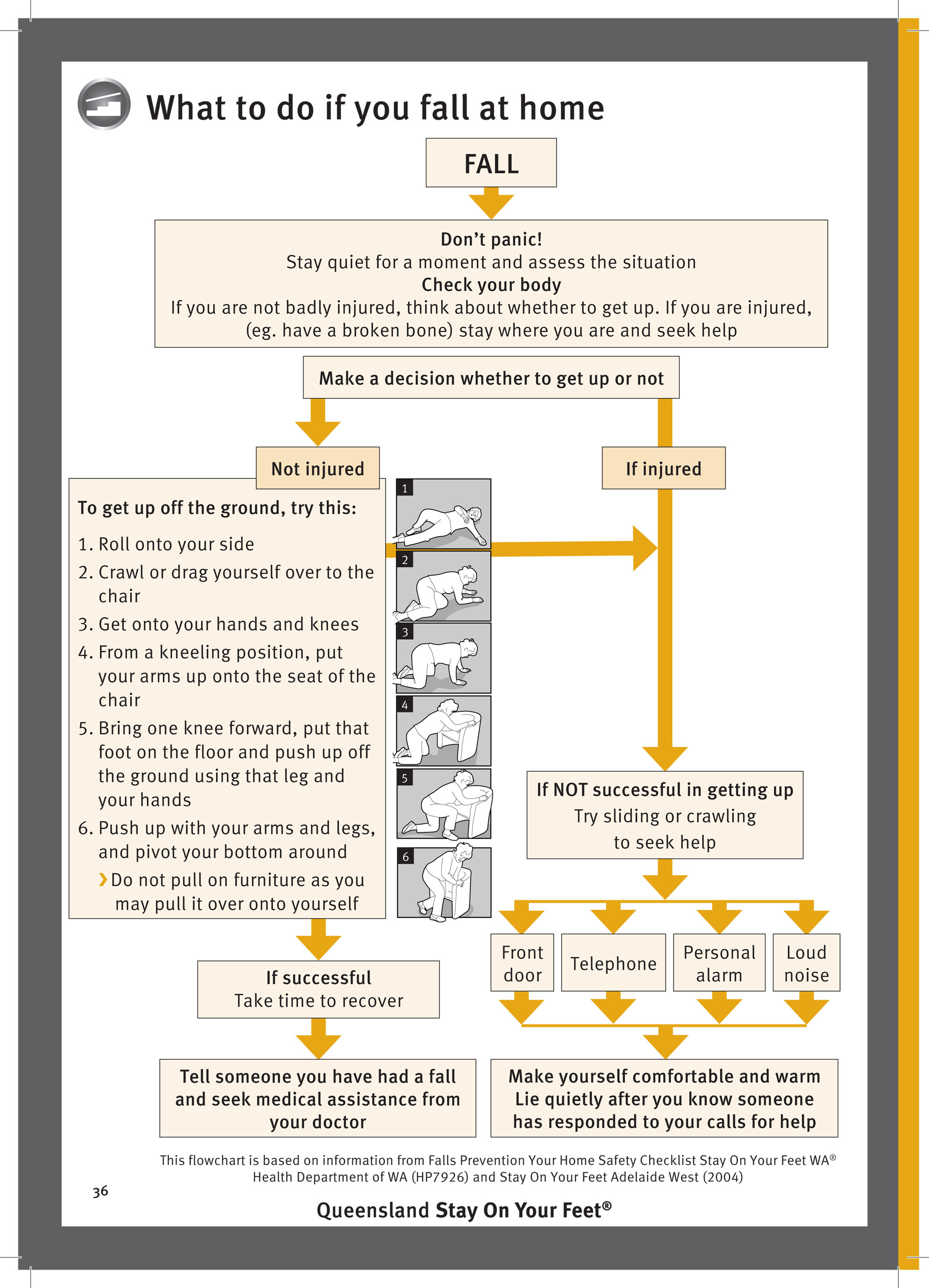
What to do if you fall at home
This handy flowchart shows what to do if you have a fall at home.
If you have had a fall, a walking aid can help to increase your steadiness and improve your confidence to be more mobile, however you will need to find one that suits your needs and learn how to maintain it.
If you are concerned that you might experience a fall, you can invest in a personal alarm to be worn around your neck or in your pocket. Some alarms are activated if the wearer falls, whereas other devices require the alarm to be pressed for assistance.
Other useful resources
- 13 HEALTH (13 43 25 84—local call)
- My Aged Care (Australian Government Department of Social Services) or call 1800 200 422
- Council on the Ageing (COTA) Queensland 07 3316 2999
- Home Assist Secure 13 QGOV (13 74 68)
- Dietitians Australia call 1800 812 942
- LifeTec Queensland 1300 LIFETEC (1300 543 383)
- Seniors in Brisbane—Brisbane City Council initiatives to support seniors in Brisbane
- You and your power wheelchair information booklet (PDF 651 kB) (PDF 651 kB)—a guide to registration, insurance, maintenance and repair and other useful tips for power wheelchair users
- Travelling with a wheelchair or mobility scooter—the Queensland Department of Transport and Main Roads has developed resources to assist users of mobility devices such as wheelchairs and mobility scooters.