

Resources for professionals and service providers
The following provides guidelines, clinical tools and consumer resources for falls prevention and management and healthy active ageing for those who work with older persons.
Falls are a common reason for older people presenting to a hospital. Falls can also occur whilst in the hospital or following discharge.
Risk factors
Falls intervention needs to be tailored to the patient based on individual risk factors.
The Australian Commission on Safety and Quality in Health Care (2025) advises that a tailored approach to preventing falls and harm in the hospital setting will consider the following risk factors:
- falls risk assessment
- continence
- dizziness and vertigo
- environmental risks
- restrictive practices
- vitamin D and calcium
- balance and mobility
- feet and footwear
- vision
- medicine and medicines review
- hip protectors
- post-falls management
- cognitive impairment
- syncope
- hearing
- osteoporosis
- monitoring and observation.
More details on the above strategies can be found in the Preventing Falls and Harm from Falls in Older People: Best Practice Guidelines for Australian Hospitals (Falls Guidelines) 2025.
Good practice
Good practice points identified by the Australian Commission on Safety and Quality in Health Care in Preventing Falls and Harm from Falls in Older People: Best Practice Guidelines for Australian Hospitals (Falls Guidelines) 2025 are:
- consider all older people in hospital to be at high risk of falls
- consider all people with mobility or cognitive disabilities to be at high risk regardless of age
- implement tailored interventions informed by a multifactorial comprehensive assessment and goals of care to systematically address falls risk factors
- ensure all health professionals involved in the care of older people receive ongoing education about falls risk and falls prevention
- ensure people are provided / have access to nutritious diets
- provide / arrange meal assistance and fluids when requested or needed to support nutritional intake and hydration
- support behavioural strategies to help regulate sleep-wakefulness cycles and improve sleep quality
- minimise disturbing noise and disruptive care practices to optimise sleep duration and quality for all people admitted to hospital.
Standards, guidelines, fact sheets and resources
Australian Commission on Safety and Quality in Healthcare:
- Falls Prevention
- Falls Guidelines in Community Care
- Preventing falls in Community Care—Fact Sheet
- Best Practice Guidelines for Australian Hospitals (Falls Guidelines)
- Preventing Falls in Hospitals—Fact Sheet
- Falls Guidelines for Australian Residential Aged Care Services
- Preventing Falls in Residential Aged Care Services—Fact Sheet
Other agencies:
- Department of Health Western Australia, Stay on Your Feet Program—Injury Matters Prevention to Recovery
- Better Health Channel Victoria—Falls—services for older people
- World Health Organisation—Falls
- Australian Institute of Health and Welfare—Injury (including falls data)
- NPS MedicineWise
- NSW Fall Prevention and Healthy Ageing Network
- Healthdirect—Older people and falls
Brochures/posters
- BE SAFE Brochure (PDF 928 kB)
- Buzz for help before you get up—poster 1 (PDF 104 kB)
- Buzz for help before you get up—poster 2 (PDF 118 kB)
- Buzz for help before you get up—poster 3 (PDF 91 kB)
- Buzz for help before you get up—poster 4 (PDF 90 kB)
- Buzz for help before you get up—poster 5 (PDF 87 kB)
- Stay on your feet®—MOVES Residential poster (PDF 2030 kB)
- Stay on your feet®—Community poster (PDF 1243 kB)
- Short Queensland Stay on your feet®—Checklist (PDF 1168 kB)
Stay On Your Feet® is a registered trademark. Please request permission for any use beyond the materials provided.
Clinical tools
- In-patient Falls Assessment and Management Plan (PDF 927 kB) (WINC Code: 1NY31686)
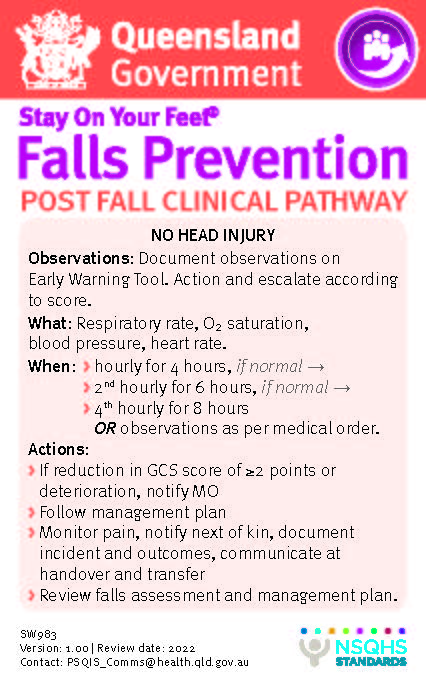
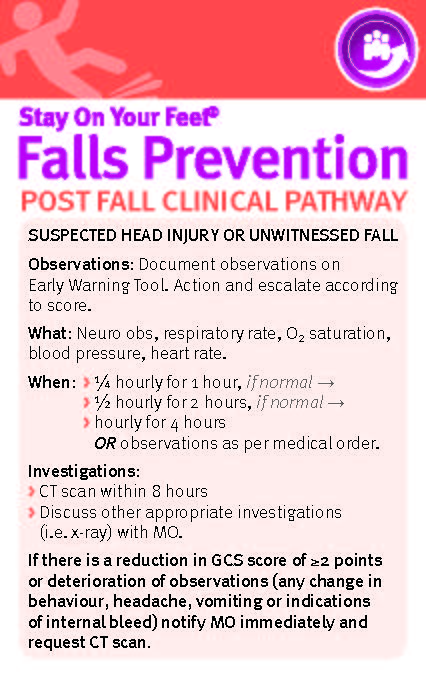
- In-patient Post Fall Clinical Pathway (PDF 2214 kB) (WINC Code: 1NY31460)
- Post Fall Clinical Flowchart (PDF 209 kB) (WINC Code: 1NY31926—DOWNLOAD ONLY)
- Residential Care and Multipurpose Health Facility Falls Assessment and Management Plan (PDF 904 kB) (WINC Code: 1NY31414)
- Residential Care Facility/Multipurpose Health Service Post Fall Clinical Pathway (PDF 213 kB) (WINC Code: 1NY31880)
- Day Oncology Pressure Injury and Falls Assessment (PDF 1012 kB) (WINC Code: 1NY31437)
- Renal Dialysis Pressure Injury and Falls Assessment (PDF 1048 kB) (WINC Code: 1NY31439)
- Community Falls Assessment and Management Plan (PDF 884 kB) (WINC Code: 1NY31427)
- Sub-Acute Post Fall Clinical Pathway (PDF 704 kB) (WINC Code: 1NY43997)
- Paediatric Falls Risk Assessment and Management (PDF 490 kB)
To order the consumer and clinical resources listed above:
- Queensland Health staff can order through WINC via a Queensland Health staff member who has WINC access and authority to order resources via credit card.
- If external to Queensland Health, you can still order the resources via the WINC website, with the
Username: 1og-statewide and Password: Statewide
Other clinical resources
- Falls magnets (JPG 16 kB) (WINC Code: 1NY31923 (LARGE) and WINC Code: 1NYU31923 (SMALL))
- Post Falls Clinical pathway falls lanyard (SW983/WINC Code: 1NY36381)
Falls Awareness Month
April No Falls is a national and international campaign to educate and raise awareness of falls prevention with the aim to reduce falls and harm from falls.
The following sites have resources to support a local Falls Awareness Month.
- Aged Care Quality and Safety Commission
- NSW Fall Prevention and Healthy Ageing Network
- Forward with Dementia
- Wuchopperen Health Service LTD
- Northern Sydney Local Health District—April No Falls
Education and training
For QH Professionals:
Please log into iLearn for the following courses:
- Comprehensive Care
- Comprehensive Care ieMR Optimisation
For non-QH Professionals:
- Interactive Falls illustration—exploring risk factors for falls in hospitals (approximately halfway down the page)
- Injury Matters—training and educational material
Videos for clinical settings:
- Falls Prevention Gold Coast Hospital and Health Service (YouTube)
- Top toileting tips to stay on your feet—Queensland Health
- Simple steps to reduce your chance of a fall in hospital—Queensland Health
- Patient Handling Videos—developed by the Health, Safety and Wellness Department and Support Services at Townsville Hospital and Health Service
- Introduction to patient handing in the bathroom
- Pre-activity patient screening: on bed tasks
- Pre-activity patient screening: off bed tasks
- Patient handling video: Sara stedy
- Patient handling video: Hopper
- Patient handling video: Standing hoist
- Patient handling video: Ceiling hoist
- Patient handling video: Bariatrics in the bathroom
- Patient handling video: Wheelie walker
- Patient handling video: Stand transfer