

Summary
What's involved in caring for someone at the end of their life? What kind of support is available for people wanting to die at home? How can people provide care for loved ones while they are in hospital?
In Episode 5 of It Can’t Hurt to Ask ... about Death and Dying, Lauren talks to Toowoomba woman Rosita about what it was like to care for her mother Johanna at home during the last year of her life.
She's also joined by clinical nurse consultant, Jane, who explains about how people can be supported by community palliative care services to care for someone who wants to die at home. Then, Dr Patty, clinical director for the Redcliffe Palliative Care Service, joins the conversation to share her insights into how people can care for their loved ones in a hospital setting.
Whether you're caring for someone, planning for the future or just want to know what it's like to support someone as they are dying, this episode will help you understand the role 642,000 Queenslanders have taken on.
This episode is part of the podcast series It Can’t Hurt to Ask ... about Death and Dying.
Featured in the episode

Rosita and Johanna
Rosita lives in Toowoomba and for the past 10 years has cared for her mother, Johanna (pictured). After living with Rosita and her family for her final year, Johanna died peacefully at home at age 99. Rosita felt it was a privilege to care for her mother during this time in her life.
Johanna's photo was taken on her 99th birthday at Rosita's home.

Jane
Jane is a clinical nurse consultant with the Metro North Community Palliative Care service. She began her nursing career in Scotland before moving to Australia where she specialised in palliative care. Jane is passionate about ensuring that people die with dignity.

Dr Patty
Dr Patty is the clinical director at Redcliffe Palliative Care Service. She takes pride in the way the service's multidisciplinary team comes together to provide holistic, person-centred care for each patient and their loved ones.
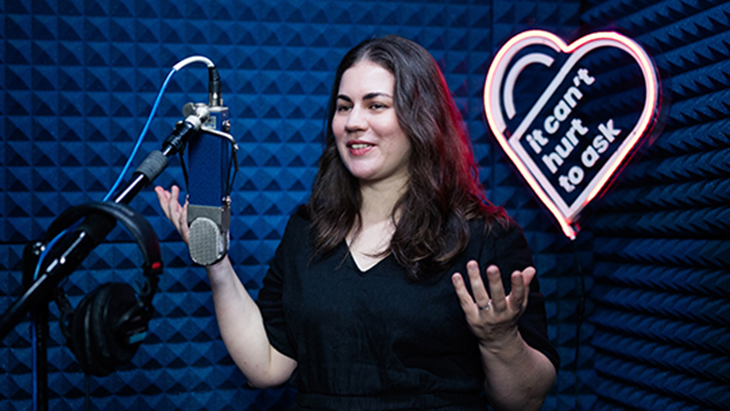
Lauren
With equal parts curiosity and caution, Lauren has delved into all things death and dying to produce and host this podcast series. She's talked to healthcare workers, allied health staff and people with lived experience from right across Queensland to get the full picture of what happens at the end of life and how we can prepare to live, and die, as well as we can.
Episode resources
Care at the end of life is a campaign and resource hub for Queenslanders with information about advance care planning and support for patients, carers and families.
Talking about death and dying can bring up challenging emotions. If you or someone you know is struggling with their mental wellbeing, support is available:
- Lifeline: call 13 11 14 (24 hours a day) if you are experiencing a personal crisis or chat to a counsellor online.
- Beyond Blue: call 1300 22 463 for broad mental wellbeing support or speak to a counsellor online.
- Griefline: call 1300 845 745 (9am–6pm, Monday - Friday, 12 noon–6pm weekends).
- PalAssist has general information and advice about palliative care services in Queensland. Call 1800 772 273 (free for Queensland residents) or chat online (from 7am to 7pm, 7 days).
- In an emergency, always call Triple Zero (000).
The following services were discussed in the episode or can provide additional information and resources:
- The Statewide Office of Advance Care Planning offers free advance care planning information and support for patients, families, carers, and health professionals. Phone: 1300 007 227 or email: acp@health.qld.gov.au.
- Apply for aged care services first by applying for an assessment. You can do this through your GP or local health service, online at the My Aged Care website, by calling My Aged Care on 1800 200 422, in-person with an Aged Care Specialist Officer at a Services Australia office.
- Any Aboriginal and Torres Strait Islander person who is 50 and over can access the Elder Care Support program. The program provides support workers who can give you information about aged care and guide you through the process of accessing services.
- Support is provided for infants, children and young people with life-limiting illnesses, as well as their parents, siblings, grandparents, school and community. Learn more via Children’s Health Queensland’s Paediatric Palliative Care Service, reach out to the Children's Health Queensland Bereavement Service via phone: 1800 080 316 or email: CHQ_Bereavement@health.qld.gov.au.
- Regional and rural patients, and their families, can access specialist palliative care services via telehealth. A referral is required from your GP, oncologist, other specialist or community nurse. Care is delivered by Specialist Palliative Rural Telehealth service (SPaRTa).
- Seniors Enquiry Line is a free, statewide information and referral service for Queensland seniors, families, friends, grandparents and carers. Phone: 1300 135 500 between 9am to 5pm, Monday to Friday.
- Voluntary assisted dying is one of several choices a person may have at the end of their life. It is important to discuss all options with your doctor. QVAD-Support provides advice and support to Queenslanders. Phone: 1800 431 371 or email: qvadsupport@health.qld.gov.au
Disclaimer
The stories and conversations shared by everyone in this podcast reflect their personal views, experiences and opinions. They are shared for informational and educational purposes only and are not intended to be a substitute for professional medical advice, diagnosis, or treatment.
Queensland Health does not guarantee the accuracy or completeness of the views expressed by guests and accepts no responsibility for any loss or damage that may result from relying on this content.
If you have questions about your health or treatment, please speak with a qualified healthcare professional.
Transcript
Lauren (in interview)
Can you tell me a little bit about your mum?
Rosita
Johanna, J-O-H-A-N-N-A, Johanna. So, she's a little Dutch lady. She was born in Holland in 1927, and she saw World Wars, she immigrated with her husband. They came with one big box of things and £20 to spend in Australia.
She and Dad made a life here that was amazing. She was born at 3 pounds and she was so tiny and they said that she probably wouldn't live, so she was put into the top drawer of a dresser when she got home because they thought she'd just pass away, and she lived 99 years. How amazing.
Lauren
That's Rosita. She's a friend of my mother's. Over the years, conversations with my mum have sometimes led back to Rosita and her mother, Johanna, as she gradually aged past 90, still living in her own home. Then, after a dementia diagnosis, Johanna moved in with Rosita who became her carer.
Rosita
For our family, that choice was, do I move in with her? Do we try and get nursing care during the day for her while I'm at work? Do I take leave from my job? Does she move in with us because we're only 3 kilometres away? What does that look like? So, there was all that decision-making.
Lauren
When I started talking to Rosita about being part of this series, she was caring for her mum at home with support from the community palliative care team at Darling Downs Health.
When Johanna passed away two weeks before we did this interview, Rosita decided she still wanted to share her experience of caring for her mother and enabling her to live her final months at home.
Rosita
I can't be sad at 99 that she didn't have enough time, you know? Like, I think it was the right time for her.
Lauren
There are 642,000 carers in Queensland who support family or friends with daily activities and personal care. Carers might look after someone who has a disability or a chronic health condition of any age, but a large proportion are like Rosita, caring for frail older people as they near the end of their life.
Caring for someone in their last years of life is a big job, with varied and changing responsibilities. In this episode, Rosita will share what it was like to care for Johanna through her final weeks, the difficult parts of becoming a carer and the joy her mum brought to their home.
I'm also going to talk to Jane, a community palliative care nurse, about how her service works with carers who are looking after someone and supporting them to die at home, and Dr Patty, a palliative care doctor who's going to talk about how people can care for loved ones in a palliative care or hospital setting.
Lauren (in interview)
Was there a point where those kinds of conversations were had with your mum about if you can't go home, what's important to you and what do you want things to look like?
Rosita
Because she had lived so long, she had seen a lot of friends at different points go through different journeys.
She didn't want to move anywhere else into any other facility. She loved her home. And so, she had been adamant to me that she wanted to stay in her own home. Absolutely adamant.
Lauren
Johanna had lived in her home in Brisbane for 50 years, including the decade after her husband had died. As she entered her 90s, she made the decision to move to Toowoomba to be closer to Rosita and her family, but remained living independently with support through My Aged Care.
Rosita
We started quite early with a support at home package, and she did move her way through a level 1, level 2, into a level 3 over the 15 years. And that was done with My Aged Care. They were very supportive and just making sure that as her needs increased, her package increased.
It was really only till her health significantly deteriorated in that November '24 that we realised we'd have to ramp up the intervention, I guess, and make some difficult decisions around what was best for her and what was responsible.
Lauren
Johanna was diagnosed with combined Alzheimer's disease and vascular dementia at age 94. Rosita and her sister, who Johanna had appointed enduring powers of attorney, had to figure out how they could honour Johanna's wishes to live at home while taking care of their mum.
Rosita
It came to the point where she went to hospital, and that is where the hospital recommended, ‘Your mother shouldn't be living at home by herself anymore.’
They were saying that her ability to look after herself just wasn't there anymore and she wasn't eating properly, forgetting to eat and she was also at very high risk of falls.
Lauren
Rosita and her sister took turns taking care of Johanna in her own home and at Rosita's, before deciding that living at Rosita's home was best for Johanna. This also meant Rosita became a full-time carer, taking extended leave from her work.
Rosita
She was actually really happy. We converted a room into a bedroom for her. So, it was a quite a decent size room, and it looked out on the gardens, which she was always an avid gardener. So, it was an easy space for her to live.
Lauren
When she was discharged from hospital, Johanna was referred to the Darling Downs Health Palliative Care Service. As we learned in episode 2, palliative care isn't just for people who are going to die soon, but for people with a life-limiting condition who can benefit from care to manage their symptoms and changing needs while continuing to go about their lives.
Rosita
The palliative care team made sure that her wishes were recorded so that anyone who treated her in the future, ambulance or whoever, a doctor, knew what it was that she wanted really clearly for her end-of-life journey.
They actually helped me get a package set up on the fridge for ambulance, if they ever visited, that had her wishes in clearly not to be resuscitated. But they also went through the end-of-life choices, and they, they really spoke a lot to mum and made sure that she could hear them and got her wishes clearly that she did not want to be in hospital.
The palliative care team put her on the inactive list, but I had every right to contact them at any stage and talk to them. She was made inactive at that time because she was quite well. She certainly physically wasn't deteriorating. They gave me information, contacts that I could read, website, things that I could find out about dementia. There's a stack of information that you can use to find out, because I don't have a nursing background at all.
Lauren
Rosita's care for Johanna became about managing her dementia symptoms and frailty, while her physical health remained quite stable. She told me that while it was a lifestyle change for both of them and she had to learn a lot about dementia and understanding Johanna's needs, there was also a lot of joy to be found in caring for her mum.
Rosita
So, I took it on as it's like a new job almost, but it's family. It's more just, ‘This is family’. And all the family helped. We were very fortunate that my son and daughter-in-law and then baby moved in with us in January because that just brought a whole new lease of life to mum to have family there.
You know, my daughter-in-law would take the baby in to have his breakfast in with mum. That's how we got her to eat breakfast because the baby was eating breakfast and we said, ‘You should eat your breakfast too.’
So, you know, there were lots of fun times and lots of laughs, and she went on trips with us. She was very portable, my mum. She was happy to jump in the car and go for a ride and towards the end she'd just fall asleep all the time in the car. But she would come places. We made trips to Brisbane together.
You just make it work one day at a time and then always just with respectful planning. Is this going to work or do we need to think of a different way of doing this?
We really needed to understand why mum was hallucinating at times, why she had delusions. She had behaviours that were not confronting but were odd. Some of her repetitive behaviours, picking at things or seeing things that weren't there or trying to find something that was lost. But when that behaviour happens repetitively over a series of months, you start to recognise those patterns.
I was fortunate, or we were fortunate, because she was never aggressive. She'd get a bit cranky, but she'd always been a little bit cranky at times. So, I knew that part of her personality, but she was never aggressive.
Once we had her room set up and I had a Support at Home package wrapped around me, and then in the last year or so, that contact with the palliative care team who I knew would give me any advice around end of life. Once I had that support wrapped around, it was just a management.
Lauren
When people like Johanna wish to stay at home when nearing the end of their lives, the team, including doctors, nurses, and allied health professionals like pharmacists and occupational therapists, help support them and their carers to make this possible.
While Johanna had continued to experience increasing symptoms of dementia and had gradually become more frail, towards the end of her life, her health began to decline more quickly after a fall.
Jane
Hi, I'm Jane, and I'm the clinical nurse consultant from Community Palliative Care in Metro North.
Lauren
I spoke to Jane to find out what kind of care is offered at home and how community palliative care teams support carers when it's clear someone is in the last weeks of their life.
Jane
Our service is normally for the last few weeks, so few weeks to short months. So basically, becoming the end of the journey as it were. We are purely community. We basically keep people at home if they want to die at home for end of life. It's about keeping them comfortable, managing any symptoms, it's a lot of education for carers and supporting family members.
Lauren
When a person nears the end of their life, they often can't get out of bed and take care of their daily hygiene needs. Jane's team teaches carers how to help with washing, changing, and toileting their loved ones.
Jane
We're teaching the families how to actually do the bed-based cares. So that's all about how they move them in the bed. We provide slide sheets. They should be on a hospital bed, air mattress by then. Sometimes we'll work with other nursing services, they might go in and do the care.
But it's just about supporting the carer.
Lauren
Jane stressed to me that daily caring is a lot of work and very hard to manage alone.
Rosita had been the main carer to help with her mother's daily cares for a few months. But it was with these kinds of jobs that she was glad to have family support, including from her sister.
Rosita
Mum was incontinent for the last probably 3 months, 4 months of her life.
How lucky am I it was only that short period of time. But my sister understood that part of it. She knew how difficult it was to have to clean an elderly person when that's not part of my background in doing that. So, when you've got someone who understands well, but also has that emotional connection, because she was our mother, that was really, really wonderful to have.
Lauren
Jane also stressed that carers needed to take care of themselves, especially as their loved one's health deteriorated. This could be using the social work services available to them or leaning on their community for support.
Jane
It's around still having time for themselves. So, if needed, we can provide a little bit of respite so they don't have to go out, just have a sleep knowing that someone's there if they're needed.
Getting friends, family on board, people making them meals. But then also restricting visitors if they need to. Because then they're having to make cups of tea or and just having that conversation with neighbours, family to say, ‘Oh, if you wouldn't mind, don't just turn up, but can you ring?’
So it's all around that. And then obviously the debriefing, and we offer support from our social worker as well.
Rosita
She did have a fall. She got a contusion on her head, and it was quite a big lump.
Lauren
When Rosita shared with me the events that led to Johanna being readmitted to her community palliative care team, the benefits of the advanced care planning they had done months before became clear in how it enabled Johanna to remain at home despite becoming an active palliative care patient.
Rosita
So, the ambulance came, and they were very kind and wonderful, and they took her to hospital. Turns out she didn't have any effects from the lump on her head, but she did have a lot of fluid on the lungs, and her heart was definitely failing.
The next morning, another doctor called, and she'd reviewed all of Mum's file, and she said, ‘I'm going to refer you back to the palliative care team, and they will give you some more support at home because I think your mum's health is declining.’
The palliative care team rang within a day and made a time to come out with a doctor. He checked Mum over, and he said that she was still reasonably well, except for the big bump on her head. They reviewed her medication. They checked the home again to make sure that we had everything set up the way that we needed to for her.
Talked to me about Mum's skin, the fragile skin that she had, checked that I had everything I needed, really.
So, it was really nice to have that in my home instead of being in hospital and having to go up and visit. The doctor didn't come again, but the nurse came again and double-checked everything and how mum was progressing, which was really well.
Lauren
The palliative care team let Rosita know they would keep in touch regularly, but that if Johanna continued to recover well at home, she might not need their regular care yet.
A few weeks later, Rosita began to notice changes in Johanna that she reported to the team, and they all agreed that her health was declining.
Rosita
This was a lady who refused to get into bed during the day. She would nap in her chair, but no way was she going to bed. That was for old people. So she was in bed, and she didn't want to get up, and the day before she'd barely eaten, and I just thought, ‘She is not well. This is going on for two days now, and it's very unusual.’
So, I rang the palliative care team and they arranged to come out, and the doctor immediately said to me, ‘Look, I think your mum is in the last days of her life because she's deteriorated so much.’
The nurse came put some medication tubes into mum, one on her right hip and one on her left hip. So, the right hip one was, continually administering pain relief, medication for anxiety and restlessness because at times she was quite distressed in the bed and calling out.
Lauren
Jane told me that these medication tubes are called subcutaneous injections which help deliver medications just below the skin. These are put in by a nurse and stay in for families to give medication as needed.
Jane
Basically, we would set the infusion up that will go over 24 hours. But in the meantime, if they're getting any pain, nausea, any symptoms, we have medication there that they can give on top, which we call for breakthrough pain, breakthrough symptoms.
We do teach some carers to actually draw up the medication themselves. For ones that aren't confident or maybe they're a bit older and they haven't got the dexterity, we will draw them up for them.
Rosita
When I rang the next morning I said to them, ‘Look, she's a bit restless. She's calling out. Her breathing, she's starting to breathe and then stopping breathing and I don't know if that's normal.’ And the nurse explained that 2 of the medications that I'd been given, I could administer.
So, she again ran me through how to do it, and there were no needles involved. It was just a click-on capsule that you pushed. Very, very simple because I've never had experience of doing any needles or anything like that. I think that was comforting that when she needed it, she didn't have to wait for anyone to come. That was already set up for me to do.
Lauren
After Rosita had administered the medication and Johanna had become settled, she left her to rest. She had a cup of tea with her husband while they waited for the nurse to come for their daily appointment.
Rosita
We had just come in from sitting outside mum's room, and my husband had noticed that mum's breathing was a little bit rattly about 10 minutes before.
And as I came to greet the nurse, I said, "I'll just put all our cups of tea and everything in the kitchen. I'll be in with you." And when she went in to check on mum, mum had passed away.
So that was amazing that in 10 minutes, without any visible distress or calling out, there was... it was incredibly peaceful, and I think that that's a lot due to the medication that they had provided that was just very effective in making sure that mum had what she wished, which was to pass away peacefully in her home.
Lauren
Community palliative care teams continue to support carers and families after the death of a person. This includes making sure they know that an expected death at home doesn't need to be treated as an emergency, and what to do in the hours after someone has died.
Jane
We have a long conversation with them beforehand about what death might look like, what to do when it happens. Basically, our job is to keep everything nice and calm so the families know that whatever they're doing, it's fine. They're doing a good job. They don't have to panic. It's not an ambulance, and it's not a police service.
Lauren
Rosita told me she was grateful to have the ongoing support of the palliative care team in her home after her mum had died, as they helped with the practical and emotional support her family needed following Johanna's death.
Rosita
I was particularly grateful that the palliative care nurse was there because she was able to guide me through the process. Even though you think you know, and you've got your head on, at that point you're just a little bit in disbelief because I hadn't seen anybody alive one moment and gone the next.
She said, ‘Look, Rosita, take a breath. There's no rush.’ And she got another palliative care nurse to come and help her, and the three of us were able to bath mum and change her and, make sure she had nice clothes on. And then she sort of prompted me, she said, ‘Well, if you want to, and you're ready, you can ring your funeral home so that you've got them organised for whatever time you want them to come and collect your mum.’
So, I'd called the funeral home and knew that they would be there by 4:00 o'clock in the afternoon to collect mum.
Lauren
For Rosita, being able to care for her mum at home, knowing that was Johanna's wish, felt satisfying even when it was difficult.
Rosita
It was a difficult time. It's not something that you enter into without considering the emotional and the toll that it takes on you. Possibly a little bit isolating from friends because although I did have people come and drop in and my age group are definitely looking at what's happening to their parents, I definitely have friends who are caring for, for their parents.
But it's made better by the fact that, you know, that's what she wanted, and that's the commitment that we made. And we got as much benefit from it as what she did because she you know, I don't know how to explain it, but as difficult as it could be and restrictive as it was, there were lots of times when it wasn't, and she was just part of the family.
I think it's the way I would like to be treated, even though that might not be a choice that I have. But it's nice to have those choices if you do, and she had that choice, and we did it. Yeah, we did it. It was a good team effort.
Lauren
Jane echoed this sense of satisfaction in her own work
Jane
For me, it's just seeing the families when you're out there go, ‘Yeah, we've got this. We can do this.’ And say we managed to keep them at home. That's what they wanted to do. And it's really, just making sure they've had a dignified death in the place that they want to be.
If we can make it a good death, a peaceful death, then we've done our job.
Patty
It is core business for pall care to have a patient-centred care approach in terms of all of the aspects of their life, but also extending beyond the patient. Being able to look at what their family and carers needs to be able to provide the best level of care that they could give.
Lauren
Redcliffe Hospital's Palliative Care Unit is bordered by a beautiful rose garden with large bright rooms and windows looking out on the blooms as they dance in the coastal breeze.
Not all people can or want to die at home. Instead, people with a life-limiting illness might be admitted to a palliative care unit like Redcliffe's.
Patty
A lot of our patients when they're admitted in hospital, they're very frail, they're very weak, they may not have that ability to ever leave hospital.
Lauren
That's Dr Patty, clinical director for the Redcliffe Palliative Care Service. After hearing the sense of purpose and peace Rosita gained from caring for her mum at home, I wanted to find out how the family and friends of people who are admitted to hospital can still be involved in their care.
Patty
That's a very good question. The roles sometimes have changed, being their partner has now incorporated the role of being a carer. Often when they come in, there's that sense of loss, of what am I, how am I gonna be a wife when the last few months being a wife meant looking after him?
In the pall care unit here, we proactively tell patients and their carers that we are happy to do all the cares that your loved one needs from a nursing point of view, we can do the hygiene, we can do the medications, we can do the feeding.
But we are also happy if the family or the friend wants to do as much or as little of it. But there are some that also want to do all of it. I think the way to approach it is to be open in communicating with the carer what they would want to do.
Lauren
Beyond health and hygiene care, loved ones can play a big role in looking after a person's comfort and enjoyment of life.
Patty
I often tell this to families and sincerely mean it, that the reason why a lot of our patients are able to stay at home is because of the good care that they've received from their family.
You knowing that, ‘Oh, he likes his glasses tucked a certain way, or he likes his toes peeking out of a blanket.’ That's not something we know. That's something that you and probably only you would know.
So, the care that a lot of our patients have received, top-notch, because they've actually had that from their loved one.
It's very rare for me to find a patient who loves hospital food, so we often say, ‘You can bring and eat anything that you would like to.’ The focus of the care for most of our patients here is comfort, not about their dietary requirements. So, I have had patients who, when we're doing rounds, would offer us KFC, would offer us pizza.
We've had patients with cultural needs that they really cannot eat what is being delivered by the hospital. So, families would bring the food that they want to eat.
We've had one patient, I recall, when I went into her single room, she had all of her paintings from the house. The family was able to do that, and we were able to accommodate that. She felt that she was at home.
Lauren
Patty told me that spending time with their loved ones, enjoying the days they had, and making memories was also a very valuable use of people's time. Even if they felt strange or perhaps guilty for spending enjoyable moments together while leaving other types of care to staff, quality time was something only they could provide.
The Redcliffe unit has recently undergone renovations, allowing for larger rooms and a nicer, less hospital-like environment, which has changed how patients, their families, and friends can access the space and relate to each other.
Patty
We've had renovations of the family room as well and outdoor area that is being used a lot by the patients and their family. I recall that I have one patient, and this, this patient of mine never stays in hospital. He always wants to go home, doesn't like the hospital setting.
But when he came down to the pall care unit, he looked around and he said, ‘Okay, maybe I'll stay for a bit longer.’ I never saw him by the bed 'cause he was always either in the garden area or he called it the café, but it was the family room. And he often remarked that, you know, ‘Dr. Patty, can you make the consult quick because I'm actually having a date with my wife.’ They used to have coffee together in that area.
Lauren
Like Jane, Dr Patty reminded me that carers need to take care of themselves too, especially when supporting a loved one through a long health journey.
Patty
I think the first thing is making sure that they look after themselves. I always tell them, ‘For you to be able to care after him, or the patient, you have to also be fit enough to care for them.’ So even as simple as going to your GP for a health checkup is important. They're also very high-risk for depression and mental health illnesses because of what's happening, so that is also very equally important to address.
We also say don't decline help if it's offered. That could be the tough one because sometimes, carers would say, ‘No, no, I can do it. I don't want to bother anybody. My kids have their own life.’ But I often tell them that this is also their way of showing that they care and they love you. The same way as you're caring for your partner is the same way as people are reaching out.
I often tell them, maybe just tell them whoever is asking if you need help, tell them something simple like, ‘Can you pick up the groceries on your way home?’ Or can you, ‘Can you just make sure that the lawn is mowed just for this week?’ Or, ‘Can you take me out for coffee? Can you be with him for 30 minutes while I'm just going to my GP?’
So, it is not part of our culture to ask for help. But if it's offered, I often tell them maybe just make it simple things so that it's not overwhelming you that you're asking for help.
Lauren
While it's their profession, hospital and health service staff who look after people as they are dying also need to consider their own wellbeing in a demanding caring job.
As we were finishing our interview, I asked Dr Patty how she balances the emotional toll of this work. As well as practical tips like yoga, eating well, and trying to have good boundaries between work and home, she told me this story about the kindness of a patient that she uses to remind herself just how valued her care has been.
Patty
I remember I had a patient. There was a massive bouquet of flowers that came to the unit. And who's that from? From this patient. I'm like, ‘But he's passed away.’
He actually wrote the letter to say, ‘Dear everyone, if you receive these flowers, means I am gone. But I really just wanted to say thank you.’
And his best mate and family came to say, ‘Look, the moment that he left the unit, he knew when he came back he wasn't gonna be well. So, he started arranging flowers to be sent on the day after he passed away.’
So, I'm like, ‘Wow.’
I kept one of the roses, 'cause I said, ‘No, no, I'll get one of these to remind me.’ Knowing that, he couldn't have been looked after better.
It doesn't make me burn out. It makes me sad, you know? But it makes me feel like, gosh, at least I did my best, and they were okay until they died.
Lauren
Carer, nurse, partner, family, friend. There are many roles we can play in the life of someone who is dying, and there are many ways for us to show our care in different settings.
I hope this episode has given you some insight into what it's like to care for someone towards the end of their life and ways carers can look after not only their loved one, but themselves.
Next time on It Can't Hurt to Ask about death and dying, we'll hear more from Rosita and Nurse Jane as we learn about what happens after someone dies.
Jane
And then once they do die, we can go out and do what's called an extinction of life.
Rosita
Mum was changed and cleaned, and that made it easier for family who wanted to come and say goodbye to her.
Lauren
Where does a person's body go after they've died? What paperwork is involved? Who do you need to call if it happens at home? It can't hurt to ask!