

Brain Map: Parietal Lobes
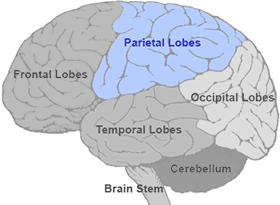
The parietal lobes are located near the back and top of the head. They are important for processing and interpreting somatosensory input. For example, they inform us about objects in our external environment through touch (i.e., physical contact with skin) and about the position and movement of our body parts (proprioception). The parietal lobes are also responsible for integrating sensory input, and construction of a spatial coordinate system to represent the world around us.
Damage to the Parietal lobes can result in:
- Difficulty with drawing objects
- Difficulty in distinguishing left from right
- Spatial disorientation and navigation difficulties
- Problems with reading (Alexia)
- Inability to locate the words for writing (Agraphia)
- Difficulty with doing mathematics (Dyscalculia)
- Lack of awareness of certain body parts and/or surrounding space (Neglect)
- Inability to focus visual attention
- Difficulty with motor planning and complex movements(Apraxia)
Contact ABIOS
abios@health.qld.gov.au