

The resources below were developed as part of the Queensland Sepsis Program, which provides statewide support to promote the early recognition and escalation of sepsis. Timely treatment of sepsis is critical to improving patient survival and outcomes.
The work is guided by the National Sepsis Program and aligns with the Australian Commission on Safety and Quality in Health Care’s (ACSQHC) Sepsis Clinical Care Standard.
Adult sepsis clinical pathways
The adult sepsis pathway is available with or without antimicrobial prescribing and administration guidelines (PDF 174 kB) and includes 4 options. Use the adult sepsis pathway flowchart (PDF 128 kB) to decide which pathway to follow.
- Adult sepsis pathway - no antimicrobial guideline (PDF 333 kB)
- Adult sepsis pathway – with antimicrobial guidelines
Queensland Health staff can order these forms from Winc.
For paediatric sepsis, use the Children’s Health Queensland paediatric sepsis pathway.
For patients between 16 and 18 years old, use clinical discretion to choose either the adult or paediatric pathway.
How to use the adult sepsis clinical pathway
- How to use the adult sepsis pathway clinician factsheet (PDF 420 kB)
- How to use the adult sepsis pathway video
- Why use the sepsis pathway factsheet (PDF 506 kB)
Sepsis clinical pathways follow the ACSQHC Sepsis Clinical Care Standard.
Adult sepsis digital downtime resources
- Adult sepsis pathway digital downtime form (PDF 333 kB)
- Adult sepsis antimicrobial guidelines digital downtime form (PDF 1147 kB)
- Adult sepsis administration guidelines (PDF 174 kB)
Paediatric sepsis resources
The Queensland Paediatric Sepsis Program is managed by Children’s Health Queensland:
Primary health care resources
Primary health care professionals play an important role in the early recognition and timely treatment of sepsis, as 80% of sepsis cases arise in the community.
- Adult Sepsis Primary Healthcare Screening Tool (PDF 238 kB)
- Sepsis Six – Primary Care Management Tool
- Queensland Virtual Emergency Care Service
Supporting patients after sepsis
Many sepsis survivors face significant ongoing health challenges, which are often managed in the primary care setting. Post-sepsis syndrome (PSS) is a group of symptoms that some people experience after surviving sepsis and can include physical, cognitive and psychological effects.
- Post-sepsis syndrome factsheet (PDF 288 kB)
- Post-sepsis screening tool (ACSQHC)
- Information for people with sepsis and their families (ACSQHC)
Clinical education
Sepsis eLearning modules are available for Queensland Health employees on iLearn.
- Adult sepsis 101 – for all staff prior to using the pathway.
- Emergency department adult sepsis case study – for staff working in an emergency department.
- Medical inpatient adult sepsis case study – for staff working in inpatient settings.
- Surgical inpatient adult sepsis case study – for staff working in surgical inpatient settings.
- Maternity sepsis case study – for staff working in maternity settings.
Sepsis courses for primary care clinicians
- Sepsis in Primary Care – Medcast eLearning module emphasising the vital role of primary care in early recognition and management
- General practitioners sepsis module – access through the Royal Australian College of General Practitioners CPD portal
Resources for clinicians
Use these resources to prompt clinicians to check for sepsis.
Information for your patients
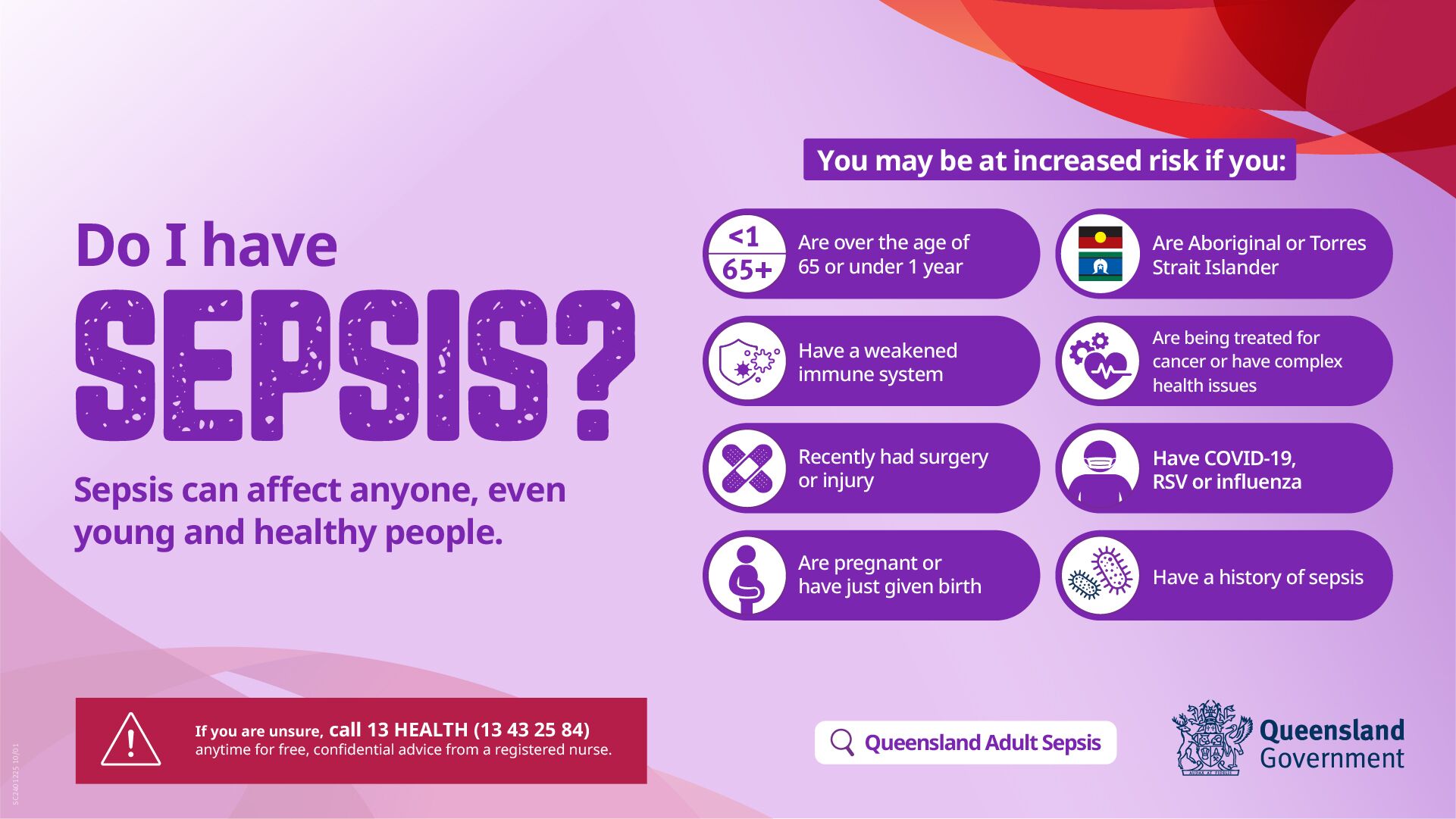
Use the following resources to help inform patients about sepsis.
Posters and screensavers
Display these resources in waiting rooms and other public areas.
- Could it be sepsis? – A4 consumer poster (PDF 368 kB)
- Could it be sepsis? – A4 consumer poster (First Nations version) (PDF 377 kB)
The 'Could it be sepsis?' - A4 consumer poster is also available in these languages:

Factsheets
The 'Have an infection? Know your risk of sepsis' factsheet is also available in these languages:
The 'Sepsis inpatient' information sheet is also available in these languages:
The 'Post-sepsis' information sheet is also available in these languages:
Contact
For more information on the pathways, please email sepsis@health.qld.gov.au.
Licence exception: The content on this page is subject to our Patient Safety and Quality copyright statement and disclaimer (PDF 296 kB). The statement doesn’t include our eLearning or paediatric resources. This content isn’t covered under the general Queensland Health copyright statement applied to other pages on this site. To register for update alerts, email sepsis@health.qld.gov.au.
Last updated: 30 July 2026